

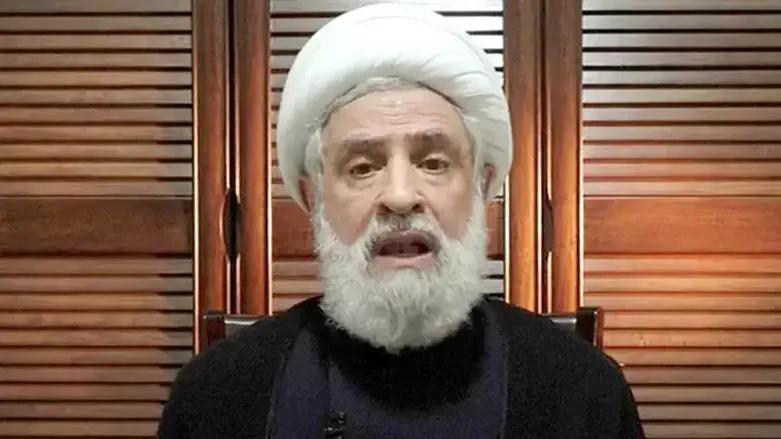
Hezbollah leader Naim Qassem delivered a defiant speech on Monday evening, making it clear that the terrorist organization has no intention of retreating from its positions despite heavy military and political pressure.
Qassem directly attacked Lebanon’s top leadership, including President Joseph Aoun and Prime Minister Nawaf Salam, claiming that US support for the Lebanese army is intended to drag the country into a civil war in order to destroy Hezbollah.
Ahead of a new round of ambassador-level talks scheduled to begin on Tuesday in the United States, Qassem stated unequivocally that Hezbollah opposes any negotiations with Israel.
“We have decided to resist and fight in order to defend Lebanon and our people," he said. “There are only two options: either fight or surrender. As far as we are concerned, surrender does not exist. Whoever wants to surrender can do so alone."
Qassem presented a unilateral list of demands as conditions for a ceasefire: a complete halt to IDF attacks, a full Israeli withdrawal from Lebanon, the release of Lebanese prisoners, the return of displaced residents, and the launch of a reconstruction process.
Regarding the fighting on the ground, Qassem praised Hezbollah terrorists, describing their performance as “legendary and astonishing." He revealed the organization’s tactics against the IDF’s ground maneuvers: “We prepared ourselves quietly and under the fog of war. Our fighters move from place to place and conduct battles in a cat-and-mouse format to prevent the enemy from gaining a foothold in the territory."
In addition, Qassem issued a direct threat to IDF troops: “Our fighters will ambush Israeli soldiers when the opportunity arises. We are fighting the enemy from all directions, and he will not know where the blow is coming from."
Qassem rejected reports of Hezbollah’s involvement in fighting in Iran or other countries, claiming there is “no proof" of such involvement. However, he called on the Lebanese government to “correct its attitude" toward Iran and the Revolutionary Guards, arguing that Lebanon should accept assistance from anyone willing to help. He concluded with a call for Arab countries to cooperate in resisting Israel.