


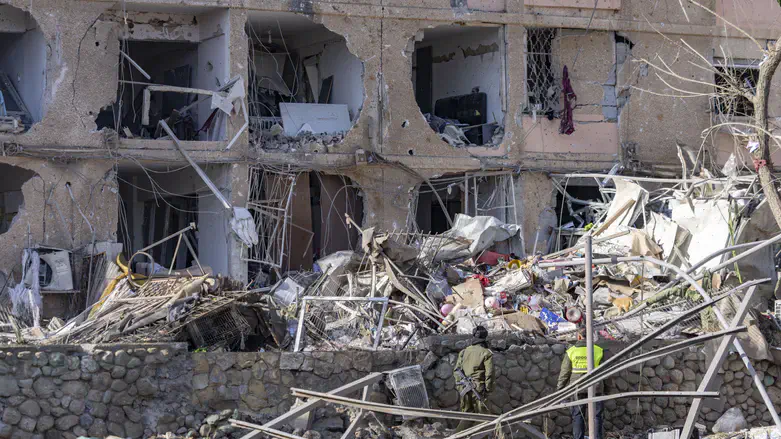
The IAF has completed a preliminary investigation this morning (Sunday) into the direct missile impacts in Arad and Dimona overnight.
The findings explain how Qadr missile ballistic missiles-carrying hundreds of kilograms of explosives-managed to penetrate the air defense system, causing numerous casualties and heavy destruction in residential neighborhoods.
In Arad, the missile struck the center of a high-rise complex inhabited by a large Gur Hasidic community. Dozens of injured people were evacuated from the scene, including 10 in serious condition. Ten Air Force helicopters were dispatched to evacuate casualties and transport rescue forces.
The investigation found that although the buildings had standard shelters, most of the injured were not inside them at the time of the explosion.
In Dimona, a similar missile hit an open area surrounded by buildings. Damage to property and infrastructure was very significant, but the number of casualties was much lower than in Arad.
The report states that recent rainfall softened the ground, which absorbed part of the blast and reduced the explosion’s impact.
Unlike in Arad, nearly all residents in Dimona entered shelters, thereby saving their lives.
Despite a 92% interception success rate against over 400 ballistic missiles launched since the start of the campaign, in these two cases, the interceptors missed. The military stated there is no connection between the miss in Dimona and the one in Arad.
The Air Force stressed that this was not due to human error or system failure. That same night, two other Qadr missiles were successfully intercepted using the exact same system.
Officials also noted that Iran is currently launching a steady rate of 10-15 ballistic missiles per day toward Israel. This morning, a Khorramshahr missile-one of the most advanced missiles in Iran’s arsenal-was successfully intercepted.