

Hours after the Iranian attack on Azerbaijan, additional details are emerging that shed light on the rift that has opened between the two countries. Photos of the debris published from the scene raise questions that Baku's security establishment is seriously investigating.
According to sources in Azerbaijan, an initial examination of debris from one of the aircraft identified markings in Cyrillic script, a finding that raises the possibility of a Russian connection or use of components that came from there. However, at this stage there is no final determination regarding the identity of the drones, and the investigation continues.
What makes the attack particularly severe is the diplomatic context that preceded it. Azerbaijani Foreign Minister Jeyhun Bayramov made clear as early as January in a conversation with his Iranian counterpart that "Azerbaijan will never allow its territory or airspace to be used by any country to carry out military operations against its neighbor Iran or any other country."
According to a political source in Baku who spoke with Arutz Sheva - Israel National News, the same message was conveyed to officials in Israel, and on March 1st, the day after fighting broke out, Bayramov repeated the same message to Tehran.
Tehran continues to promote a narrative according to which Israel used Azerbaijani territory for attacks, a claim that Azerbaijan categorically denies.
According to the source, "They are looking for justification and recycling a claim that has no basis," and the pressure in the Iranian system is being translated into additional targets in the nearby arena.
The source further claimed that Nakhchivan is not just a point on the map. "The enclave is perceived in Baku and Washington as a central link in the Zangezur Corridor, a major trade route being promoted with support from elements in the United States and meant to connect Azerbaijan and Central Asian countries to Europe and reduce dependence on routes passing through Russia and Iran. In Tehran they view this project as a strategic challenge, and a strike on Nakhchivan is also seen as a blow to the entire initiative."
Azerbaijan has a special place in the geopolitical landscape that Iran has created around itself. A large Azerbaijani minority lives in Iran, estimated at tens of millions, and relations between the Tehran regime and Azerbaijani identity have been a source of political and cultural tension.
"We must also mention Azerbaijan's uniqueness in the Muslim world regarding Jewish community life - approximately 30,000 Jews live in Azerbaijan, and Krasnaya Sloboda near the city of Quba is sometimes called 'the Jerusalem of the Caucasus.' The attack on Azerbaijan is also an attack on the Muslim country that maintains the deepest ties with Israel."
The source also noted that "Azerbaijan's army is not the largest in the region, but it has gained combat experience in the Nagorno-Karabakh wars and is armed with advanced weapons, including systems from Israel and Turkey.
"A strike on Azerbaijan is in effect also a challenge to Turkey, its ally and a NATO member state. While Iran is fighting against the United States and Israel, opening an additional front against Baku and Ankara is perceived in Baku as a move that further complicates Tehran's position.
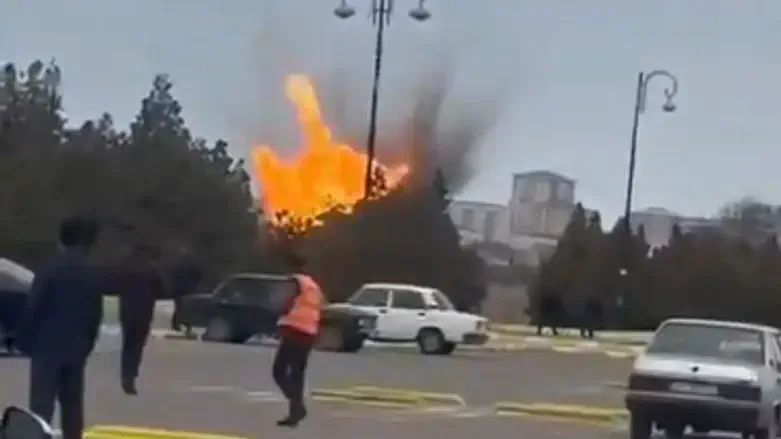
On Thursday morning around 11:00 local time, two drones that came from the direction of Iran struck the Nakhchivan enclave. One of them hit directly at the international airport terminal, and the second crashed near a school in the village of Shahraba. Two civilians were injured and children were evacuated from schools in the area.
The Azerbaijani Foreign Ministry issued an immediate condemnation, summoned the Iranian ambassador for a reprimand and delivered an official protest.
The Azerbaijani Defense Ministry even issued a sharp official statement, stating that "the Islamic Republic of Iran bears full responsibility for the incident" and that the army is "preparing the necessary measures to protect the territorial integrity and sovereignty of Azerbaijan."
"These acts of aggression will not go unanswered," the statement added. Azerbaijani President Ilham Aliyev also defined the attack as an "act of terror" and warned that a response will come.