

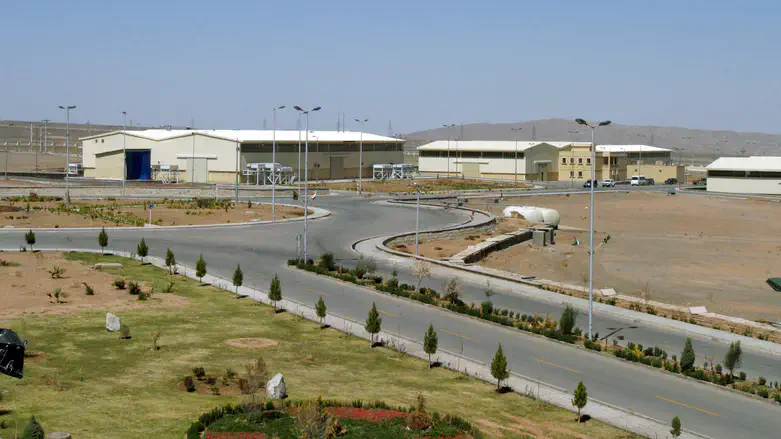
As tensions soar over Iran's bloody crackdown on nationwide protests, satellite images show activity at two Iranian nuclear sites bombed last year by Israel and the United States that may be a sign of Tehran trying to obscure efforts to salvage any materials remaining there, The Associated Press reported on Friday.
The images from Planet Labs PBC show roofs have been built over two damaged buildings at the Isfahan and Natanz facilities, the first major activity noticeable by satellite at any of the country's stricken nuclear sites since Israel's 12-day war with Iran in June.
Those coverings block satellites from seeing what's happening on the ground, right now the only way for inspectors from the International Atomic Energy Agency (IAEA) to monitor the sites as Iran has prevented access.
Iran has not publicly discussed the activity at the two sites. The IAEA, a watchdog agency of the United Nations, did not respond to requests for comment.
According to AP, which cited experts who examined the sites, the new roofs do not appear to be a sign of reconstruction starting at the heavily damaged facilities. Instead, they are likely part of Iran's efforts "to assess whether key assets - such as limited stocks of highly enriched uranium - survived the strikes," said Andrea Stricker, who studies Iran for the Washington-based Foundation for Defense of Democracies, which has been sanctioned by Tehran.
During last year's war, Israel targeted the Iranian nuclear sites first, followed by US strikes using bunker-busting bombs and Tomahawk cruise missiles. Iran has not allowed IAEA inspectors to visit the sites since the attacks.
The main above-ground enrichment building at Natanz was known as the Pilot Fuel Enrichment Plant. Israel hit the building June 13, leaving it "functionally destroyed," and "seriously damaging" underground halls holding cascades of centrifuges, the IAEA's director-general, Rafael Mariano Grossi, said at the time.
Planet Labs PBC images show Iran began in December to build a roof over the damaged plant. It completed work on the roof by the end of the month. Iran has not provided any public acknowledgment of that work. Natanz's electrical system appears to still be destroyed.
Iran also appears to be continuing digging work that it began in 2023 at Kūh-e Kolang Gaz Lā, or "Pickaxe Mountain," a few hundred meters south of the Natanz complex's perimeter fence. Satellite images show piles of dirt from the excavation growing in size. It is believed to be building a new underground nuclear facility there.
At Isfahan, Iran began building a similar roof over a structure near the facility's northeast corner, finishing the work in early January. The exact function of that building isn't publicly known, although the IDF at the time said its strikes at Isfahan targeted sites there associated with centrifuge manufacturing.
Meanwhile, imagery shows that two tunnels into a mountain near the Isfahan facility have been packed with dirt, a measure against missile strikes that Iran also did just before the June war. A third tunnel appears to have been cleared of dirt, with a new set of walls built near the entrance as an apparent security measure.
(Arutz Sheva-Israel National News' North American desk is keeping you updated until the start of Shabbat in New York. The time posted automatically on all Israel National News articles, however, is Israeli time.)