

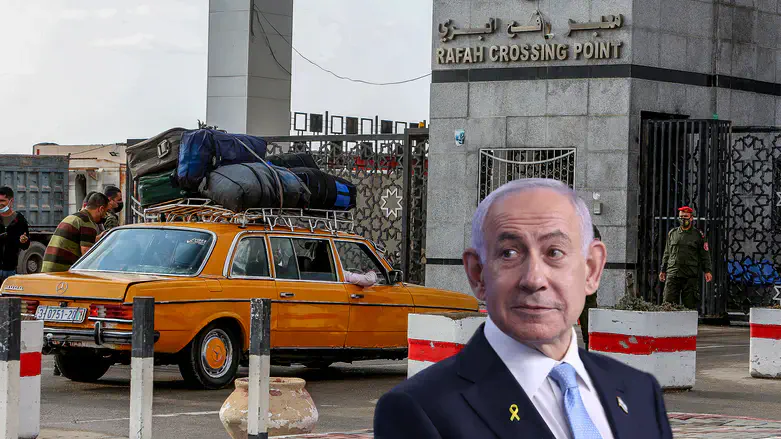
Military correspondent Doron Kadosh analyzed the Cabinet’s decision on the Rafah crossing, identifying what he describes as a series of contradictions that, he believes, hollow out the Cabinet’s publicly stated position.
According to Kadosh, ministers were not asked to vote on opening the Crossing, as approval had already been granted in advance under President Trump’s “20-point plan." He questions why, under those circumstances, the Prime Minister’s Office announced last week that a Cabinet discussion would take place, while in practice, Kadosh says, ministers were merely informed of the decision rather than taking part in it.
He also raises the possibility that the operation to locate the body of hostage Ran Gvili in the Sajaiya cemetery was timed to blunt public criticism over the opening of the Crossing. Kadosh says he is particularly concerned that Israel is, in effect, “legitimizing" Hamas by allowing the move to proceed.
“If Israel allows the Rafah Crossing to open," Kadosh argues, “it is essentially giving official confirmation that Hamas made a ‘100% effort’ to return all fallen hostages. That is quite an Israeli compliment to Hamas."
He emphasizes what he calls "the facts on the ground": “Hamas dragged its feet for many weeks in obtaining information about Gvili, failed to pass on all the information in its possession, and the current military operation is based solely on Israeli intelligence, not Hamas intelligence. Putting this gently, that is not a 100% effort."
Kadosh adds that this assessment is shared by the IDF, which explicitly briefed yesterday that it “did not identify any great eagerness or strong commitment by Hamas to find Gvili."
He concludes by asking why, in light of all this, the Prime Minister’s Office would offer what he describes as a compliment to Hamas.