

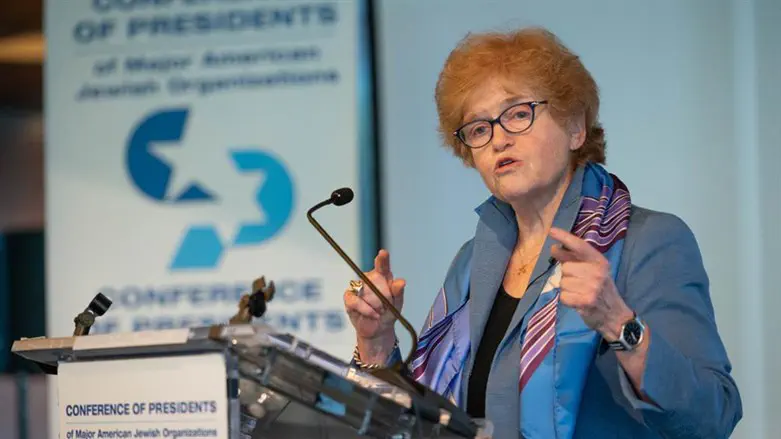
Deborah Lipstadt, who served as antisemitism envoy under former US President Joe Biden, criticized former Vice President Kamala Harris’s campaign team, after Pennsylvania Governor Josh Shapiro revealed that they asked him if he was “an Israeli agent" while vetting him as Harris’s potential running mate.
“This report is extremely distressing. When vetted by the White House for my position as Special Envoy, I was not asked anything akin to this. Had I been, I would have responded that the question is an example of why an Envoy is necessary. It is classic antisemitism," wrote Lipstadt in a post on social media.
In a subsequent post, she added, “The more I read about Josh Shapiro’s treatment in the vetting process, the more disturbed I become. The questions to him, I repeat, are why they needed a Special Envoy on antisemitism. These questions were classic antisemitism."
Aaron Keyak, who served as Lipstadt’s deputy, voiced similar criticism in a statement he issued.
"The minimum demand of Jews in the United States and our allies - even those in public service - is to simply be treated like any other American, regardless of religion, ethnicity, or race. That Governor Josh Shapiro wrote that he was asked if he was a double agent of the world's only Jewish state is an antisemitic inquiry," said Keyak.
"While we can safely assume that asking all potential Vice Presidential picks if they are an Israeli double agent is not included on the standard list, the obvious question is why it was Governor Shapiro who was targeted by the staff of the presumptive Democratic Presidential Nominee, Kamala Harris, in particular. The truth is, we almost certainly know why," he added.
"Unfortunately, this is not the first time the US government or a presidential campaign has applied a double standard to American Jews during the vetting process for a wide range of officials. I have heard from too many being asked similar questions over many years and I can speak from personal experience. During my vetting process I faced questions in a classified setting that my fellow non-Jewish political appointees did not. These sort of antisemitic questions are anti-American and do not represent the best that the Democratic Party offers. Now and especially during the next Presidential campaign we must demand better," concluded Keyak.
The statements come after The New York Times published excerpts from Shapiro’s new memoir, Where We Keep the Light, which is scheduled for release on January 27.
In the book, Shapiro writes that the vetting process for Harris’s running mate was far more contentious than publicly understood, particularly regarding questions about his views on Israel.
“Had I been a double agent for Israel?" Shapiro wrote, recalling a last‑minute question from the vetting team. He said he responded that the question was offensive and was told, “Well, we have to ask."
Shapiro noted that he understood the questioner was “just doing her job," but added that being asked such questions “said a lot about some of the people around the VP."
A representative for Harris did not respond to a request for comment.
Shapiro was a finalist to become Harris’s vice presidential pick, but she ultimately chose Minnesota Gov. Tim Walz.
President Donald Trump, who defeated Harris in the 2024 election, has several times since insisted that Harris did not pick Shapiro, whom he said would have been a stronger choice than Walz, because of his Jewish heritage.
Shapiro previously denied that antisemitism played a role in his not becoming the Democratic Party’s vice presidential nominee and said Trump was the “least credible person" when it came to standing up against hatred and bigotry.
He then clarified, “Antisemitism played absolutely no role in my dialogue with the vice president. Absolutely none. It is also true that antisemitism is present in our commonwealth, in our country and in some areas within our party, and we have to stand up and speak out against that."