

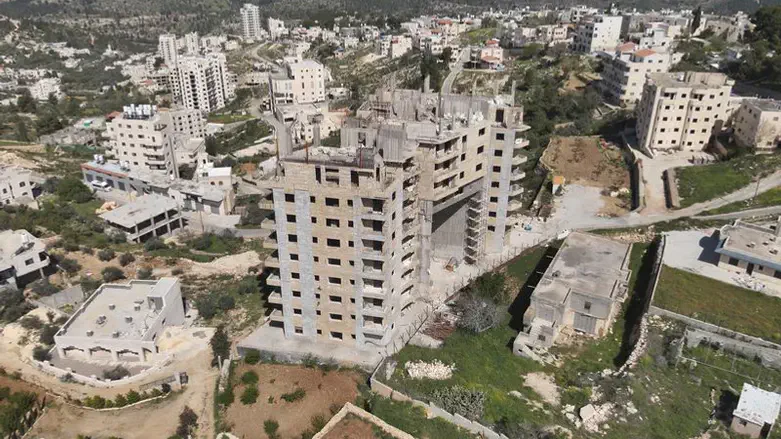
The Jerusalem District Court has dismissed a petition submitted by the Regavim movement and the Gush Etzion Regional Council concerning two apartment buildings built on the outskirts of a PA village south of Jerusalem, near the security fence.
During the hearing, the state argued that enforcement measures had already been taken, including the issuance of a stop-work order, and that there was therefore no justification to continue the legal proceedings. The court accepted the state’s position and dismissed the petition.
Regavim described the structure as highly unusual, consisting of two interconnected 12-storey towers containing dozens of residential units and covering a total area of 8,472 square meters. The movement compared the project to the Holyland complex in Jerusalem’s Malha neighborhood, noting that dozens of workers are reportedly on site daily and that construction is close to completion.
The petition was filed at the end of 2025 following repeated appeals by Regavim to enforcement authorities that, according to the movement, received no response. Regavim claimed that the state only addressed the issue after the petition was submitted, relying solely on the posting of a stop-work order as evidence of enforcement.
The movement further alleged that the Palestinian Authority is attempting to expand into nearby Area C lands under the jurisdiction of the Gush Etzion Regional Council and the municipality of Jerusalem, in an effort to establish a physical position in the area.
Roi Drucker, Regavim’s director for Judea and Samaria, said that authorities ignored multiple warnings about the construction until legal action was taken. He argued that stop-work orders are frequently issued but not enforced, allowing illegal structures to remain in place for years. Drucker described the situation as a failure of enforcement and claimed that the project is part of a broader effort by the Palestinian Authority to establish a permanent presence near Jerusalem and undermine Israeli sovereignty.