
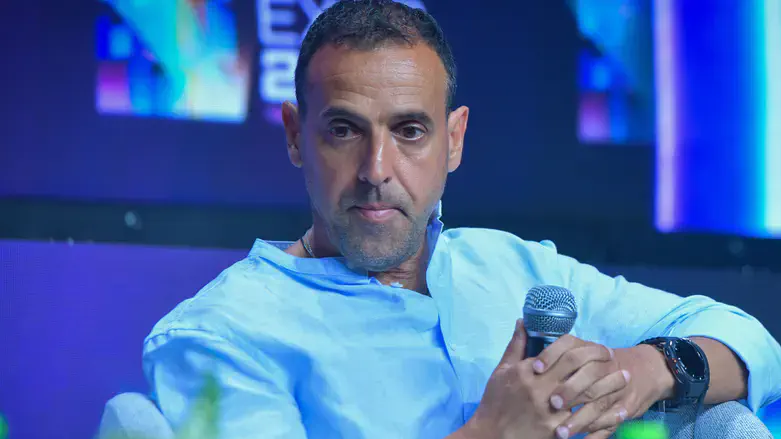
Former hostage Eli Sharabi spoke on Tuesday with 103FM about his experience in captivity in Gaza and the long road he has traveled since his release.
Sharabi recalled that even while in captivity, he was convinced his release was inevitable. “There was a sentence that annoyed the others who were with me - I kept saying it was only a matter of time until we were freed. For me, it was completely clear," he said.
He described the intense psychological pressure exerted on the captives. “They used a great deal of psychological terror. It’s very hard to ignore when they tell you that your family has forgotten you and that nobody cares," Sharabi said. “I told myself I didn’t know what the politicians were doing, but there are professional people who are working to free us day and night, and eventually we would be released."
Sharabi emphasized the total isolation they endured. “We didn’t watch television or listen to the radio. We weren’t exposed to anything," he said. “But I was 52 years old - you understand how things work. This isn’t a pizza you put in the oven and take out after 15 minutes. I had great trust in the defense establishment and in the values of the State of Israel, which does not leave anyone behind. Many things happen behind the scenes. That’s how agreements are reached."
Today, Sharabi said he is rebuilding his life outside Kibbutz Be’eri, where he lived for 35 years. “I’m constantly active - no complaints. New things are happening all the time," he said. “I’m rebuilding my life outside the Be’eri community, and it isn’t simple after so many years. I’m excited about these new beginnings. I don’t know how to act like a martyr - that term insults me. Things happen. There are situations. If crying helps someone, that’s fine, but it’s not for me."
Sharabi also shared a recurring dream he had while in captivity. “I dreamed that I would return, take Lian and the girls, give them a week or two to pack, and move to England, where Lian is from," he said. “The look I see in my daughters’ eyes - I couldn’t go back to the Gaza border area. I imagined meeting them at the border and telling them we wouldn’t live there anymore."
However, he said his outlook has since changed. “My worldview changed completely. I love this country, and I joined in the fight to bring back my brother’s body. It was a natural process."
Later in the interview, Michal Nagari, the mother of Maj. Roi Nagari, who was killed in action in Be’eri on October 7, joined the broadcast. She described her son’s actions that day. “Roi was a civilian in every respect, but also an active reservist who loved his unit," she said. “On October 7, he put on his uniform, closed the door, placed a Book of Psalms in his bag, and mobilized his team."
Nagari recounted how her son led his team into the kibbutz. “He told them not to look directly at the bodies," she said. “By evening, he managed to rescue Roni and her young son from the Baruch family home. Later, they encountered terrorists at another house. When Roi entered the kibbutz, he felt he was fighting for his home."
Sharabi responded emotionally, praising Maj. Nagari’s bravery. “I understand who Roi was. It’s incredible how you speak about his self-sacrifice and his love for the country," he said. “I wish there were 200 more like him. In the end, people like Roi stood up and acted according to their values and saved so many lives in Be’eri. Thank you."
The interview concluded with Sharabi reflecting on what he misses most. “I miss family life - Shabbat meals, the car rides taking the girls to their friends," he said. “We listened to music and talked about their week. It reflected the values I tried to pass on to my daughters."