
When I first met Cantor Phil Sherman, New York’s mohel to the stars, I didn’t know what was in store.
A mohel is a professional circumciser who carries out the circumcision ceremony known as a Brit Milah in Jewish tradition.
While learning to be a mohel myself, my in-laws suggested I shadow him for the day. As it turned out, that particular day was ordinary for Phil but extraordinary for me — five Brit Milah ceremonies spread out among Manhattan, New Jersey, and Long Island. I later learned that this was nothing compared to his record of nine in one day. His car looked like it had driven across the US multiple times, and in terms of mileage, I’m sure it had.
We hit it off right away, trading stories and talking shop as we traveled. What was clear right away was the wealth of knowledge Phil possessed. The first Brit Milah I observed was revealing. I couldn’t believe how quickly and methodically he worked, not to mention his ability to create a meaningful service while injecting a joke or two to ease the tension.
The friendship that was born that day spanned years. Due to geographic distance, we didn’t get to see each other often but when we did, it was as if no time had passed. Whether in Israel as Phil met a new granddaughter or on the Upper West Side grabbing coffee during one of my visits to the States, we always found the time. And between visits there were phone calls and WhatsApp jokes.
However our relationship was more than that. Phil became a mentor as I began my career as a mohel. I never hesitated to reach out with a question and he was always available despite the time difference.
I was shocked when Phil told me of his diagnosis. “Pancreatic cancer,” he said, while making me swear to keep it a secret. He was never much for sharing his personal life with his clients, especially if it would be a burden. He only ever wanted to help.
Things got harder as time wore on. Treatments took their toll; and those who needed Phil’s help sometimes voiced their frustration when he couldn’t officiate their ceremony. Who could blame them? They had no idea, and everyone wanted the best for their newborn — and everyone knew that was Phil.
One of our last conversations was about what Phil would do for the High Holidays. Being the consummate cantor, he had never been a congregant and wasn’t even a member of a shul. He feared he’d have nowhere to go. But the larger Jewish community he’d spent his career serving helped him in his time of need. It wasn’t easy for him to let someone else take the helm, but it meant so much to be taken care of.
Phil has been gone for just over two years, and I’m sure there are many who miss him around the world. I think of him often when I hear a good joke or when I pick up the phone to call, only to remember he’s no longer around.
When Phil’s daughter reached out a few months ago to tell me they were expecting and asked me to be the mohel, of course I agreed. But the range of emotions I experienced was not simple. I was honored that they trusted me, but I thought back to the times Phil visited to meet his granddaughters. To say he was a doting grandfather is an understatement. But I also remember him hoping that someday he’d be able to come to Israel to perform his grandson’s Brit.
As the due date grew near, I became more concerned about the timing. I had a call in to do a Brit Milah in Thailand around the same time as Phil’s grandson was due to arrive. As the birth in the Far East was delayed, my blood pressure slowly rose. In the end, the two events were five days apart. Although I didn’t get to see much of Bangkok, I was thankful to be able to perform both ceremonies.
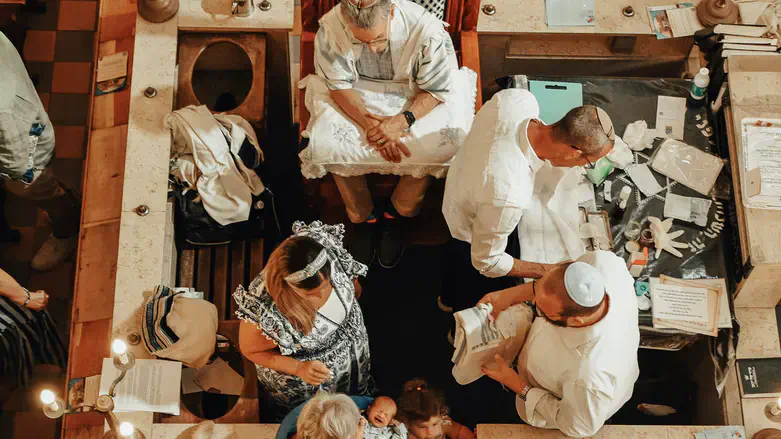
Phil’s grandson’s Brit Milah was held in Tel Aviv, in a vibrant shul, surrounded by family and friends. As I began to organize for the event, I envisioned an alternate reality of being in the same location, only watching Phil set up. At that moment, Phil’s son handed me a Brit Milah kit containing his father’s tools. It felt like he was there with us.
A few days earlier, just after I returned from the 48-hour journey, my father-in-law asked, “why do you do these trips?” At the time it caught me off guard and I had no answer. But after giving it some thought, I realized — it’s because of Phil.
Phil once told me that his first Brit Milah was in the middle of a blizzard. He and another up-and-coming colleague trekked through the snow from Manhattan to Riverdale just to make sure the baby had his Brit Milah on time. To some this may seem crazy but to those of us like Phil, it’s just what we do.
Phil's daughter and son-in-law named their son Liam, after her late father. The name has two meanings depending on its spelling. When spelled with the Hebrew letter Ayin, it means “my nation.” But they chose to spell it with the letter Aleph, meaning “resolute protector.”
Phil spent his life protecting the Jewish people, whether it was leading people in song or allowing them to fulfill their first Mitzvah. I am grateful to have called him my mentor and my friend, and every time I take the tools of the trade in hand, I carry a piece of his legacy forward.
The writer is a rabbi, a wedding officiant, and a mohel who performs ritual circumcisions and conversions in Israel and worldwide. Based in Efrat, Israel, he is the founder of Magen HaBrit, an organization protecting the practice of Brit Milah and the children who undergo it.