

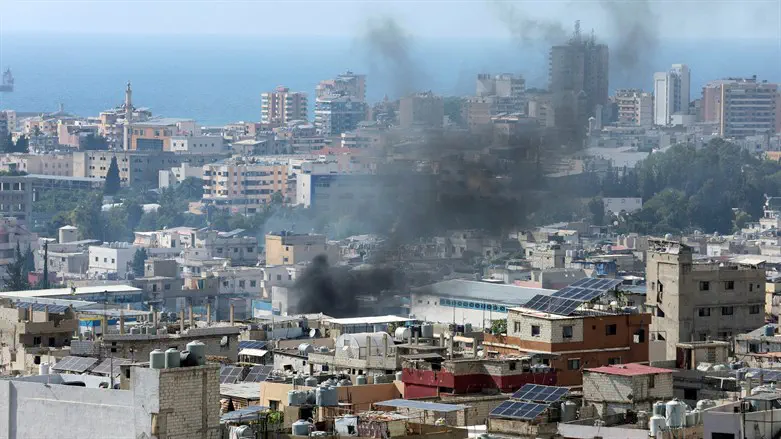
In a modest first step towards disarming Palestinian Arab factions in Lebanon, some weapons were handed over to the Lebanese army on Thursday from a “Palestinian refugee camp” on the outskirts of Beirut, reports The Associated Press.
This initial move implements a plan announced three months ago by Palestinian Authority (PA) chairman Mahmoud Abbas and Lebanese President Joseph Aoun.
The weapons transfer, which took place at the Burj al-Barajneh camp, involved a single pickup truck loaded with machine guns and rocket-propelled grenades. Ramez Dimashkieh, head of the Lebanese-Palestinian Dialogue Committee, called it “the first step, with further batches to be delivered in the coming weeks from Burj al-Barajneh camp and the rest of the camps.”
However, not all Palestinian Arab factions have agreed to abide by the plan. Representatives of the terror groups Hamas and Palestinian Islamic Jihad (PIJ) did not respond to requests for comment. A statement signed by “the Palestinian Factions in Lebanon,” sent by a Hamas spokesperson, dismissed the handover as "an internal organizational matter within the Fatah movement" that "has no connection, near or far, to the issue of Palestinian weapons in the camps."
The statement further declared, "Our weapons have always been and will always be linked to the right of return and the just Palestinian cause and will remain so as long as the occupation remains on Palestinian soil."
The “Palestinian refugee camps” in Lebanon have historically operated outside full Lebanese state control and are home to various armed Palestinian Arab factions.
These camps have witnessed internal clashes in recent years, impacting surrounding areas. Ceasefire agreements meant to end the violence have normally collapsed within hours.
Lebanese residents who are registered as “Palestinian refugees” and their descendants who were born in that country and who reside in the "refugee camps" have limited work options and are refused citizenship.
The agreement to remove weapons from these camps was seen as a precursor to the much more difficult task of disarming the Hezbollah terrorist group, which fought a war with Israel last year.
Lebanon’s cabinet recently tasked the army with formulating a plan for disarming Hezbollah by the end of 2025.
Hezbollah leader Naim Qassem, who took over following Israel’s elimination of Hassan Nasrallah, has been adamant that the terrorist organization "will not hand over its weapons as long as the occupation exists and aggression continues."