

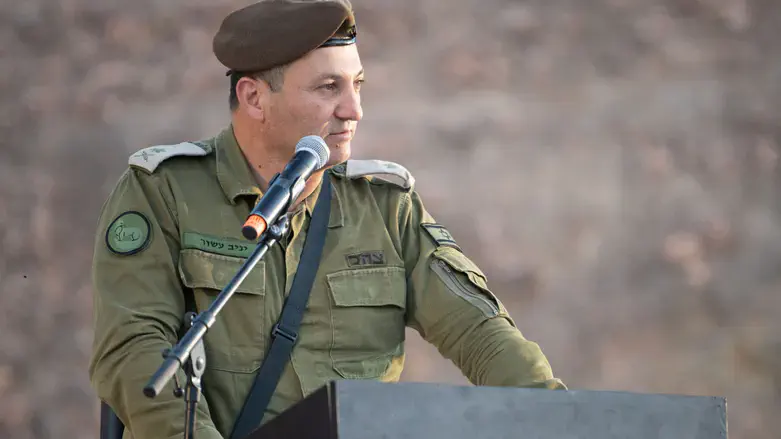
IDF Southern Command Chief Major General Yaniv Asor recently criticized the involvement of the IDF in political issues, stressing the damage both to the IDF itself and to the public's trust in it.
In a comprehensive article published in the Ma’arachot journal before assuming his position, Asor analyzed the relationship between the IDF and Israeli society in light of the October 7th failure. Asor describes the security system's failures, the public’s loss of trust in the IDF, and the dangers posed by politicization and erosion of manpower.
“The Hamas attack on October 7, 2023, and the ongoing 'Iron Swords' war, led to a crisis of trust between Israeli society and the IDF, with a focus on senior command, a crisis that has creeped into and permeated the military's ranks,” Asor wrote.
He noted, “At the heart of the belief was the concept adopted by the heads of the security system and the army that Israeli society had a resilience problem and could not bear the costs of war. As a result, strategies were developed that 'circumvented' the issue, of the type that do not come with the price of increased fighting based on intelligence superiority and crossfire; and from there, the ground maneuver was pushed aside.”
In his article, Asor pointed to the destructive impact of the "small and smart army" concept: “The idea of a 'small and smart army' is another clear expression of the manpower concept. Practical expressions of this idea can be seen in the government decision to shorten service from 36 to 30 months, closing units and brigades, especially in the ground forces, while expanding intelligence, cyber, and defense units.”
He emphasized, “The scope of the war, and its duration, lessons, and the security challenges ahead require us to adopt the approach of 'a large, smart, trained, equipped, and funded army.'”
Asor extensively reviews the erosion of the warrior ethos in the IDF. According to him, “The warrior ethos, expressed in the 'every young man is fit for arms' concept, has been eroded by a 'significant and technological service' ethos.” He added that, “In contrast to the psalm 'He who watches over Israel neither slumbers nor sleeps,' the IDF introduced 'quiet week' several times a year,” and also noted that “In a leading technological unit competing in the high-tech world, they developed a similar service concept, encouraging early returns home during the week, called 'Personal Tuesday.'”
Regarding IDF-society relations, Asor warned against the harmful impact of politicization: “Israeli society is undergoing a long process of identity clarification and deep social division. Unfortunately, the IDF serves as a battleground for various political and ideological agendas, which have intensified in recent years, damaging both the IDF and public trust.”
Addressing the status of reserve soldiers, calling them “the serving minority”: “A reality where there is no equality in duties, but there is no notable preference in rights for those who serve, creates dangerous discrimination against the serving minority.” He argues that there should be a significant increase in recognition, compensation, and preference for reservists over non-servicemen..
On the topic of haredi conscription, he wrote: “In the current and evolving reality, haredi conscription is a clear security need. The ability to integrate haredim into the IDF and through this to develop social solidarity and additional values is a historic opportunity that we must fully realize.”
Asor concluded his article with a firm statement: “The multi-theater war we are currently in has brought security issues back to the forefront, especially the recognition of the need for a large, smart, equipped, and funded army that we can trust. Therefore, it is right to base the ethos on a nation that is conscripted, not a volunteer army.”