
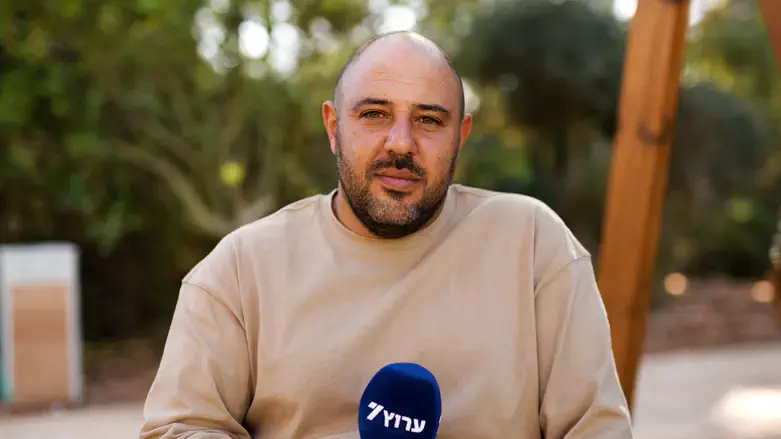
When Moshe Adika woke up in the intensive care unit at Beilinson Hospital after a nine-and-a-half-hour operation, he was convinced he had lost part of his body. Only when his father lifted his left hand, in which he had no sensation, into his field of vision did he realize that doctors had managed to save it.
Speaking on a special podcast as part of the "Marching and Saluting" initiative run by Ammunition Hill and the Ministry of Heritage to mark the 5787 Day of Appreciation for Those Wounded in Israel's Wars and in Terrorist Attacks, Adika, a member of the IDF Disabled Veterans Organization's Beit Halochem center, recounts his severe injury, his struggle with post-traumatic stress disorder and the new mission he has found in life.
Adika was called up for reserve duty on October 7 and deployed with his fellow soldiers to Judea and Samaria. On March 8, 2024, he was severely wounded during an encounter with terrorists when an explosive device detonated, injuring the left side of his body. He was evacuated by helicopter to Beilinson Hospital, where he underwent emergency surgery and received eight units of blood.
He recalls, "I woke up and felt that something was missing from my body. My parents came to see me in intensive care, and I was arguing with my father, telling him: Dad, something is missing from my body. Dad, I don't have an arm, I don't have a leg".
Doctors managed to save his arm, but Adika still has significantly restricted movement, loss of sensation and hearing impairment in his left ear. Despite the difficulties he faces every day, he seeks to put his injury into perspective.
He says, "It's just an arm, just an arm. I have friends who didn't come back, friends who had their legs or arms amputated, or lost their sight".
Hebrew Video
Alongside his physical rehabilitation, Adika had to contend with another injury, one he had not previously understood. He explains, "I wasn't familiar with the term post-traumatic stress disorder. We were brought up differently, to push forward, to be first, and no one talked to us about the psychological side".
His first panic attack struck while he was driving, leaving him frozen and unable to continue as hundreds of vehicles backed up behind him and their honking only intensified his distress. When police arrived, he managed to write them just one sentence, "I was severely wounded in the war".
The officers understood his condition, stayed with him for three hours and even called him after he returned home to check on him. The incident made him realize that alongside treating his body, he also needed to attend to his mental health.
Despite his severe injury, Adika decided to return to reserve duty, this time in a logistical role. It was important to him to rejoin his teammates, who had been present when he was wounded and carried painful memories of the incident.
His return to work was also gradual. From one hour a day, he progressed to two, three and four, and he can now work almost a full day.
A new mission also emerged from his personal rehabilitation journey. At Beit Halochem, Adika and his partners established the "Let's Talk Practicalities" initiative, which gives young wounded veterans practical tools for integrating into civilian life while coping with their injuries.
About 1,200 wounded veterans attended the initiative's launch event, and around 100 new participants registered with Beit Halochem and the IDF Disabled Veterans Organization. Members of the initiative are now also working to establish "The Quiet Corner", a safe space for those coping with combat trauma and post-traumatic stress disorder.
Another initiative he founded, "Strength in Motion", incorporates challenging sports activities into rehabilitation. Its members have set goals including kayaking in Scotland, climbing Mount Kilimanjaro and running the New York City Marathon.
For him, the athletic achievement is not the main point. The real importance lies in the months of training together, the bonds formed among the wounded veterans and the journey they share.
On the Day of Appreciation for Those Wounded in Israel's Wars, Adika specifically asks not to be called a hero. He says, "I don't like being called a hero of Israel. I did what I was taught, I did what I was raised to do. I love this country more than I love myself".
He closes the conversation with a message of hope, "I have a disability, I am wounded, but that isn't all there is to life. You can keep going and you can cope, and those little setbacks will ultimately lift you so high-all the way to the New York City Marathon".