
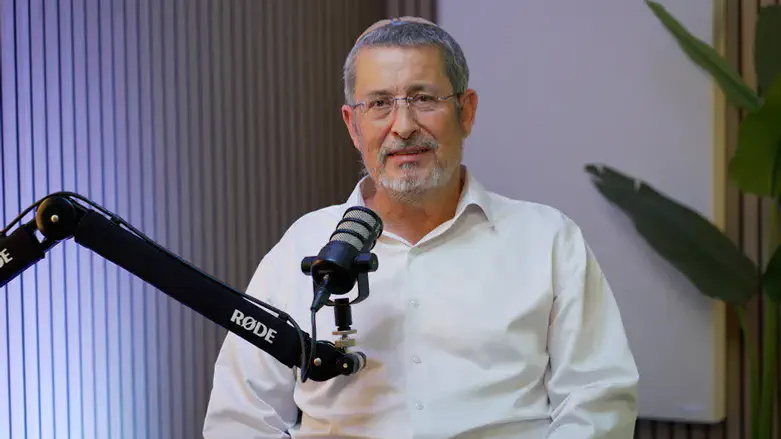
Rabbi Haim Rettig, head of the Binot hesder yeshiva in Ra'anana, discusses the challenges facing the religious-Zionist community in a conversation with Dvir Amar on a podcast. He expresses concern over its internal divisions and calls for renewed ties between its different streams, while also sharing his personal story and the path that led him to establish the yeshiva 22 years ago.
Rabbi Rettig describes the complex challenges the yeshiva faced during the war, when many of its students were called up for reserve duty. He was also mobilized, serving, among other roles, as a division rabbi.
The yeshiva, which had only begun recovering from the COVID-19 crisis, was left without students and had to navigate a difficult situation. Some of its students continue to serve in the reserves, but Rabbi Rettig stresses that the people of Israel need them.
The yeshiva recently moved to the Ohel Ari synagogue complex in Ra'anana, where it operates alongside the Tzalash beit midrash, headed by Rabbi Peretz Einhorn.
He says, "Two batei midrash in one place provide a strength that was lacking in general, and in Ra'anana in particular", stressing the importance of working together with love for the Jewish people, unity and joy in Torah.
Rabbi Rettig recalls that when he arrived in Ra'anana, he believed he could bring about a Torah revolution in the city. Over the years, he learned to appreciate the cumulative impact of educational work, establishing Torah institutions and nurturing educators.
He sums up his educational approach in three principles: a sense of mission, Torah scholarship and excellence, whose Hebrew initials form the word "shalem", meaning "whole". He says everyone should feel a sense of mission, deepen their Torah study and strive for excellence in their relationships with others and in their service of God.
Discussing Naftali Bennett, who has long been associated with Ra'anana, Rabbi Rettig openly expresses appreciation for his abilities, alongside reservations about his political path.
He says, "I know people are very angry with him. I still think he is not in his natural place. I think he has talent that he needs to know how to direct to the right place".
The rabbi says that before the elections, he sent Bennett the words of the Mishnah, "Know where you came from, where you are going, and before whom you will ultimately give an accounting".
During the conversation, Rabbi Rettig returns to his childhood in Kiryat Shmona and the story of his father, who was 61 when he was born. His father lost his first wife, his two children and other relatives in the Holocaust. After fleeing to Russia during the war, he returned home to discover that his family had been murdered.
In 1957, he immigrated to Israel with his new family, settled in Kiryat Shmona and opened the city's first butcher shop.
Rabbi Rettig remembers his father as a man of extraordinary resilience, who showed no sign of fear even when Katyusha rockets fell on Kiryat Shmona. He says this quality influenced him and his children, who served as combat soldiers in the IDF.
His own path into the world of Torah study was far from assured. When he first approached Yeshivat Hakotel, he was not accepted, and gained admission only after Rabbi Tzefania Drori intervened.
He recalls, "I came with almost no knowledge", remembering periods when students did not want to study with him as a partner because he had attended a secular school and they feared he would slow their progress.
That experience stays with him to this day and shapes his educational approach. At the yeshiva he heads, he seeks to give every student an opportunity to grow in Torah, regardless of their starting point.
Rabbi Rettig, who was among the founders of the hesder yeshiva in Nahariya, also speaks candidly about the difficulties that accompanied the establishment of the yeshiva in Ra'anana. Over the years, it had to move between different locations and struggled to attract students.
Despite the challenges, he has no intention of giving up on the Torah institution he established. He says, "I will not close a yeshiva. If the Holy One, blessed be He, decides to close it, let Him close it. I am not closing it".
On the issue of drafting haredim into the IDF, Rabbi Rettig presents a clear halakhic position. He says that during a war to save Israel from an enemy, Torah scholars are also obligated to enlist.
He says, "Coming to Israel's aid against an enemy - everyone is obligated, a groom from his chamber and a bride from her wedding canopy, and all the more so Torah scholars".
At the same time, he recognizes the educational complexities involved in drafting members of the haredi community and concerns about harm to their way of life. Based on his military experience, he believes that a significant influx of haredim into the IDF could actually strengthen the military's religious and Torah character.
Rabbi Rettig favors reaching a compromise that would broaden participation in military service without undermining the world of Torah study. If no agreement is reached, he supports financial sanctions but opposes arrests.
Later in the conversation, Rabbi Rettig expresses concern about the fragmentation of the religious-Zionist community into groups and camps. He stresses that the disagreements extend beyond politics to educational, Torah and social outlooks.
Although he does not identify with the "Kav" stream of yeshivas, he expresses great appreciation for their work. He calls for Rabbi Zvi Tau, members of the Kav yeshivas and the Noam party to be brought back into the mainstream of religious-Zionist public life.
He says, "I do not think we have the luxury of splitting into ten parts", emphasizing the significant contribution of the yeshivas and pre-military academies associated with this community.
Ahead of Hanukkah, Rabbi Rettig draws inspiration from Rabbi Kook's words about bringing different lights together. He expresses hope that religious Zionism will rise above its disagreements and reunite.
He says, "I deeply lament the fact that the religious-Zionist tribe has shattered into fragments. Perhaps the religious-Zionist community will have the wisdom to bring all these fragments back together in one place".