

At 3 a.m., attorney Daniel Gordon awoke at his home in Chicago without knowing why. His wife was surprised by his unusual awakening, and he felt an unease he could not explain.
At that same hour, according to information he received later, IDF soldier Eitan Dov Rosenzweig was killed in action in the northern Gaza Strip. Gordon had prayed for his safety every day, although the two had never met.
The connection began through a Western Wall Heritage Foundation initiative that assigned Jews around the world the names of IDF soldiers, encouraging them to pray for their safety and dedicate good deeds to their merit. Gordon received the name, "Eitan Dov ben Hagit Esther" and from that moment, the unknown soldier became part of his daily routine. He recited Psalms for his safety, studied Torah in his merit and took care to recite the Asher Yatzar blessing followng bodily funcions with particular concentration, praying for his protection.
On the morning of 8 Kislev 5784, Gordon arrived at his synagogue in Chicago. As worshippers around him excitedly discussed reports of progress toward the first hostage deal, he struggled to shake the heaviness he had felt since waking. After the service, he remained in the synagogue and recited Psalms for Eitan.
A short time later, after arriving at his office and sitting down at his computer, he came across the devastating news: Eitan had been killed in action in Jabaliya. When he checked the details, he discovered that the reported time of death was 11 a.m. in Israel-3 a.m. in Chicago, precisely when he had awakened.
For Gordon, the coincidence was deeply unsettling. The soldier whose name he mentioned in his daily prayers was no longer anonymous. He now had a face, a family and a life story cut short.
The story, reported by journalist Yisrael Hershkowitz in Mishpacha, took a moving turn three years after Eitan's death, when Gordon met the soldier's father, Uzi Rosenzweig of Alon Shvut.
At the meeting, the father recalled the morning soldiers arrived at the family home to inform them that his son had been killed. Eitan, who was 21 when he died, had studied at hesder yeshivas in Yeruham and Gush Etzion. After completing his compulsory military service, he was called up to fight when the war broke out.
On the morning he was killed, he and his fellow soldiers set out on a mission in an orchard in Jabaliya, where Grad rockets prepared for launch had been discovered. Eitan was hit during an exchange of fire and killed at the scene. The deputy company commander was wounded in the same incident and later recovered.
Days after his death, Eitan's fellow soldiers came to the family home, bringing pages found in the combat vest he had worn. The pages, stained with his blood, contained Chapter 32 of the Tanya, printed in Gaza by Chabad members. Eitan had carried them close to his heart.
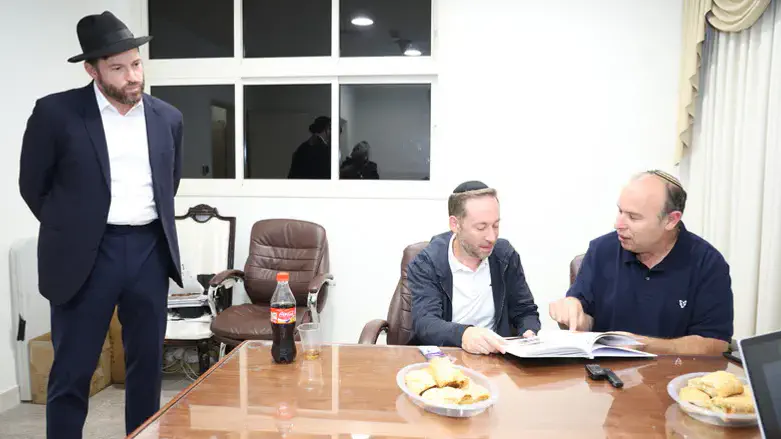
But Eitan was more than a soldier. During his conversation with Gordon, his father opened a photo album and shared stories that revealed a curious, creative and thoughtful young man with a rich spiritual life and a deep love for others.
Even as a child, he stood out for his smile and talents. He practiced the sacred scribal arts, studied and created, and during the coronavirus pandemic devoted considerable time to an unusual artwork, The Scroll of Jewish Destiny-Gum Arabic, Gallnut Extract and Copper Sulfate. The 3.6-meter-long work, drawn in black and white using a quill and ink, is displayed at the Israel Museum.
Motifs from his work were also incorporated into the Torah ark in Mevo Horon and at Eitan Farm near Hebron. For his family, these works offer further testimony to the inner world of their fallen son.
His father said that when the war broke out, Eitan made sure soldiers had Schottenstein editions of the Talmud, seeking to sustain Torah study even during the fighting. Alongside his love of study, he was known for his ability to listen to others and connect with people whose backgrounds differed from his own.
One example was the close friendship he formed with a fellow soldier from a secular, left-wing background. After Eitan's death, the friend came to comfort the family in Alon Shvut, although his parents had initially been apprehensive about the visit. A few days later, that friend was also killed in action.
During the conversation, Uzi Rosenzweig also recalled two earlier incidents in which his son's life had been spared. Eitan was at Mount Meron during the disaster there but managed to leave the area where it unfolded. According to his father, only a few steps separated him from those who died.
On another occasion, during his military service, he was caught in a terrorist ambush in Huwara. Bullets flew around him, but he was unharmed. In retrospect, those incidents took on added significance for his family.
Meanwhile, across the ocean, Gordon was grappling with difficult questions. After learning of Eitan's death, he began wondering whether he had done enough for him. Had he prayed with sufficient concentration, and could he have devoted more Torah study or good deeds to his merit?
Those feelings of guilt stayed with him until he shared them with his friend Rabbi Eliezer Sember, principal of the religious elementary school where Gordon serves as president. The question was later also put to Rabbi Shaul Alter, the rosh yeshiva in Jerusalem.
Rabbi Alter's response, sent by fax, was unequivocal, "Heaven forbid... I believe he will yet come to see the benefit of his prayers and study for the fallen soldier."
Gordon, Uzi Rosenzweig and Rabbi Shaul Alter later met in the rosh yeshiva's office. Beforehand, they posed for a photograph near the spot where Eitan used to stand during the Hasidic gatherings known as tishes on Ziv Street in Jerusalem.
During the meeting, the closeness of Eitan's connection with Rabbi Alter became clear. After his death, the rosh yeshiva had visited the Rosenzweig family in Alon Shvut to offer condolences. He said simply, "I loved him," and described him as someone who "was pure and untainted."
Speaking with Eitan's father and Gordon, Rabbi Alter explained his understanding of the spiritual connection among Jewish souls, which is not limited by time or place. He compared that bond to the connection between the letters of the Torah, emphasizing that Eitan had fallen while performing a mitzvah-defending the Jewish people-after a life interwoven with Torah study and good deeds.
Toward the end of the meeting, Uzi Rosenzweig spoke of the family's wish to publish a book collecting Eitan's works and introducing his artistic and spiritual world to a wider audience.
Gordon did not hesitate. The man who had long prayed for the safety of a soldier he had never met offered to cover the book's publication costs.
It brought full circle a connection that began with a single name assigned to a Jewish man in Chicago through a prayer initiative, continued with the devastating news of a soldier's death in Jabaliya and, three years later, became a partnership to commemorate the life and work of Eitan Dov Rosenzweig, of blessed memory.