

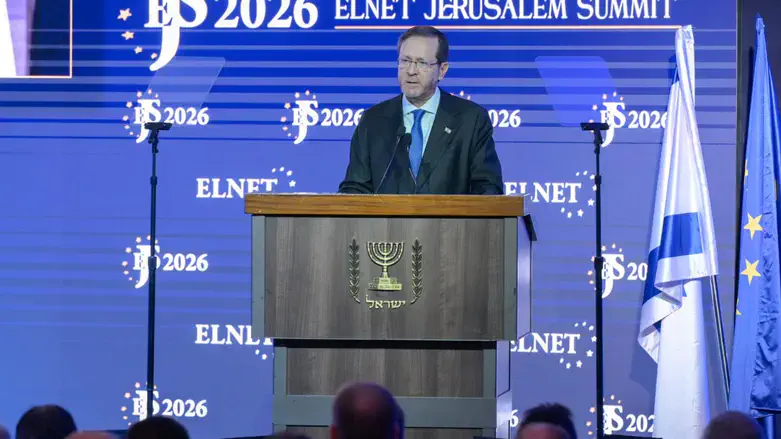
Israeli President Isaac Herzog on Monday addressed the ELNET Jerusalem Summit, which brought together Israeli and European leaders alongside partners from the United States and delegations from the United Arab Emirates, Morocco, and Somaliland.
In his speech, President Herzog condemned recent violence by Jewish extremists in Judea and Samaria, and warned against rising antisemitism and the demonization of Israel in parts of Europe. He emphasized the value of Israel-Europe cooperation, the Abraham Accords, Israel’s peace agreements with Egypt and Jordan, and the India-Middle East-Europe Economic Corridor.
Addressing the recent violence by Jewish extremists in Judea and Samaria, Herzog said, "I want to address the headlines over the past number of days that I am sure disturb all of you as much as they do me. There is no room for ambiguity here: Violence by Jewish extremists against innocent people and communities in the West Bank-Judea and Samaria-or anywhere else, is despicable and deserves strong condemnation. It is an assault not only on human beings, created in the divine image, but on the ethical way we carry, on our history as a people, and on God himself. It most certainly does not represent Israel."
He added, "I assure you that our law enforcement agencies are working diligently to scour this terrible moral stain and arrest, investigate, and prosecute any perpetrators of violence to the fullest extent of the law, in line with our values as Jews, as Israelis, and as human beings."
Addressing the rise in antisemitism and anti-Israel activities in Europe, President Herzog said: "In a Europe that, not so long ago, turned on its Jews and on itself, today the Jewish nation-state is demonized. Across European capitals, Jewish communities contract in fear, denied, once again, their simple, clear belonging. This is pure antisemitism."
"I have repeated this many times: Disagreeing with Israel on its strategy or on a political solution with the Palestinians is legitimate. Constructive discussion, on even the most contentious subjects, can serve the goals we all share. But that is not what is going on in Europe or elsewhere.
"What touches our deep nerve of alarm is that blaming the Jews has become, once again, the default mode, the easiest solution for so many. This dangerous slide into familiar patterns of hatred erodes the moral underpinnings of society everywhere. And we should be very clear: It works against Europe itself."
Herzog stressed, "In stepping forward to face down subversive and destabilizing forces who sow terror and chaos, we in Israel are protecting ourselves. But we are also protecting Europe and the Free World at large-from jihadism, terror, and the Iranian empire of evil. What is so painful to us is that, having sacrificed so much and so many, we are also demonized, isolated, and shamed by the very world we are fighting to defend."
"The fact is that these decades of alliance between Europe and Israel have not only helped remedy the deepest shadows of our history. They have also spoken to the enormous promise of what we can constructively build together in the interests of all of humanity. Through intensive collaboration and cooperation between Israel and Europe, our best and brightest minds have worked together shoulder-to-shoulder on finding solutions to questions that belong to us all. And it has been a blessing to our societies and nations all over the world.
"I know that here at this conference you have the pleasure of being addressed by Professor Hossam Haick of the Technion. I myself had the privilege of awarding this pioneering Arab-Israeli scientist the Presidential Medal of Honor just recently. His collaboration with European peers through Horizon Europe is a reminder of what becomes possible when knowledge is allowed to travel and brilliant minds are empowered to work together for everyone’s benefit."
Addressing Israel’s relations with the nations of the Abraham Accords, Egypt, and Jordan, President Herzog said: "We share excellent relations with the UAE, and I personally deeply value my relationships with its leaders. I am so pleased that representatives of the UAE are with us here today, alongside a terrific delegation from Morocco. I see in this a deeply encouraging and salient sign of the transformation of the long-standing ties between our peoples into deepening diplomatic ties that are rich with promise."
"At the same time, we have a remarkable partner in the Kingdom of Bahrain and our ties are deepening as well, and I greatly enjoyed meeting the Foreign Minister just a few weeks ago, and I look forward to further deepening ties.
"The path toward peace in our region did not begin with the Abraham Accords. This rests largely upon strategic peace agreements with our two closest neighbors: Egypt and Jordan. Our relationship with Egypt has stood as an anchor of regional peace for nearly 50 years. It began when two bold and visionary leaders disrupted decades of war, bloodshed, and enmity in favor of a stable and enduring peace between our nations.
"The peace agreement with the Kingdom of Jordan followed. And to this day, we share with Jordan critical arrangements, major strategic interests, and our longest border.
"Jordan is a very important country in our region, and there is no question that its goals, needs, and concerns, which His Majesty King Abdullah II and the Jordanian government express in openness and goodwill, deserve our concerted attention and address. Our channels of dialogue with Jordan and with Egypt must remain as open and beautiful as the Jordan Valley that stretches between us."