

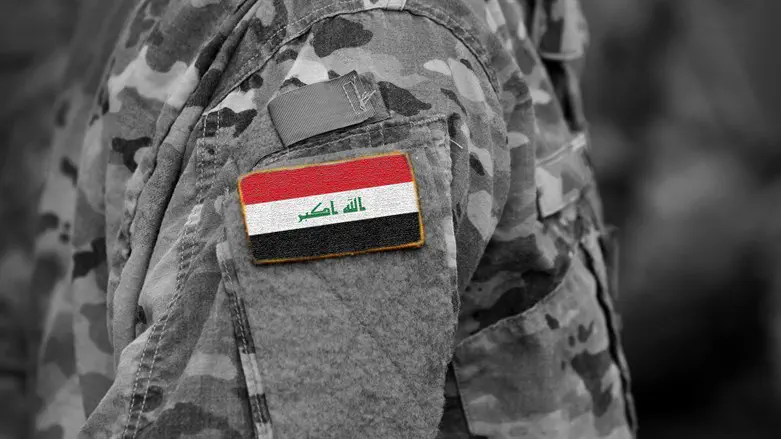
Iraqi security forces deployed across the Jurf al-Sakhar district in Babylon province on Friday, taking control of positions previously held by the Iran-backed Kataib Hezbollah militia following days of escalating tensions between the armed group and the government.
The deployment began after Prime Minister Ali al-Zaidi ordered the establishment of a joint command headquarters comprising army units, police, Popular Mobilization Forces (PMF), and Energy Police personnel.
Iraqi security sources told Al Arabiya/Al Hadath that the first phase of the transfer of positions to government forces had been completed without reported violations or confrontations.
The new headquarters is responsible for coordinating security operations throughout the district, also known as Jurf al-Nasr, alongside military and police commands in Babylon, Karbala, Anbar, and Baghdad.
Speaking during the operation, Iraqi Armed Forces spokesman Sabah al-Numan said the redeployment was proceeding normally and announced that the government intended to launch strategic development projects in the area.
Security Media Cell chief Saad Maan confirmed that Energy Police had assumed responsibility for protecting an oil pipeline. He added that security forces would begin reopening roads to civilians and facilitate the return of displaced families.
Baghdad Operations Command announced that a major road connecting Latifiya, Qamishli, Fadhiliya Bridge, Jurf al-Sakhar, and Jamaliya to Karbala would reopen to traffic in both directions on Saturday.
Addressing the forces stationed in the district, Zaidi described the operation as part of his government's effort to establish state authority throughout Iraq and place all armed formations under a unified command.
"We are not fighting a battle," Zaidi said, urging security personnel to exercise restraint and avoid unnecessary confrontations.
He declared that all armed groups would eventually operate under a single military command and legal framework, emphasizing that no weapons or military decisions should remain outside the government's authority.
Zaidi also stressed that the government's current approach was based on containing armed factions rather than excluding them.
According to Al Arabiya/Al Hadath, the prime minister instructed officials to prevent political figures from entering Jurf al-Sakhar during the operation to reduce the risk of tensions.
The deployment followed a Friday deadline imposed on Kataib Hezbollah to withdraw from the district and transfer control to federal security forces.
The confrontation escalated earlier this week after a government investigation identified suspected illegal oil-smuggling operations, unauthorized refining facilities, and breaches in pipelines in the militia-controlled area.
Zaidi subsequently dismissed nine administrative officials and security commanders over alleged involvement in the activities.
Kataib Hezbollah denied the accusations, insisting that the facilities were used to supply fuel to military vehicles, generators, and equipment. The organization also accused the government of attempting to force it to surrender its weapons.
On Thursday, Kataib Hezbollah confirmed that its leader, Abu Hussein al-Hamidawi, had met with IRGC Quds Force commander Esmail Qaani, Badr Organization leader Hadi al-Amiri, and PMF chairman Faleh al-Fayyadh to discuss the standoff.
The militia described the talks as positive.
Kataib Hezbollah operates within Iraq's Popular Mobilization Forces, which formally answer to the prime minister, but has repeatedly acted independently of government instructions.
The developments come amid Zaidi's wider initiative to bring armed factions under government control, with June 30, 2027, established as the deadline for placing all weapons under state authority.