

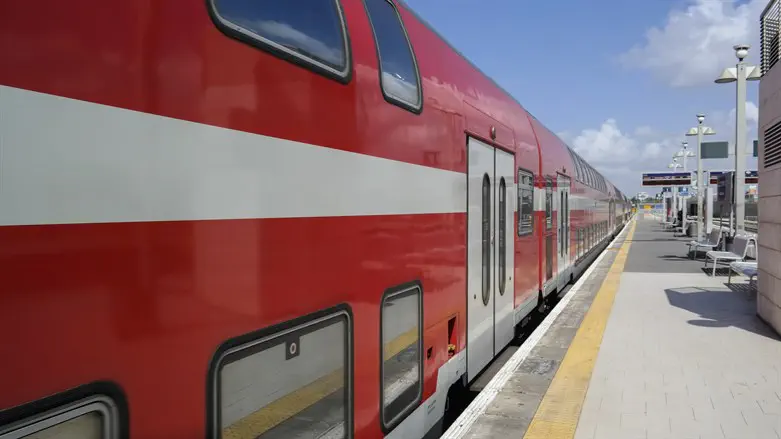
Israel Railways will expand service on its high-speed Jerusalem line beginning Sunday, November 29, increasing the number of trains during peak hours from two to three per hour in each direction.
The changes will affect trains connecting Jerusalem's Yitzhak Navon station with Ben Gurion Airport, Tel Aviv, Herzliya, and Netanya. The additional trains will operate during the morning rush hour, from 6:00 a.m. to 9:00 a.m., and the afternoon and evening peak, from 3:00 p.m. to 7:00 p.m.
As part of the expansion, Netanya station will receive five trains per hour during peak periods.
Service between Jerusalem and Modi'in Center will also be increased, with two additional morning trains scheduled between 7:00 a.m. and 9:00 a.m.
On the Jerusalem-Hadera route, two trains will be added between 5:00 a.m. and 6:00 a.m., one in each direction. Israel Railways will also introduce minor timetable changes at Hadera West station to improve the spacing between departures.
The increased frequency follows infrastructure and technological upgrades, including the introduction of an advanced railway signaling system that allows more trains to operate on existing tracks while maintaining safety and improving punctuality.
The Jerusalem high-speed line is the first in Israel to use the system, which is expected to be introduced on other routes in the future. The technology is also intended to increase railway capacity along the busy Ayalon corridor.
Meanwhile, Israel Railways is preparing to open an additional entrance to Jerusalem's Yitzhak Navon station in the coming weeks. The new access point, located near the Supreme Court and the Shazar parking lot, is intended to reduce congestion and improve passenger movement through the station.
The company is also moving forward with plans to extend the high-speed railway deeper into Jerusalem through an underground route reaching the historic Khan station area.
Two new stations, Jerusalem Center and Jerusalem Khan, are being built as part of the project, with the aim of improving access to central Jerusalem and distributing passenger traffic more efficiently throughout the city.