
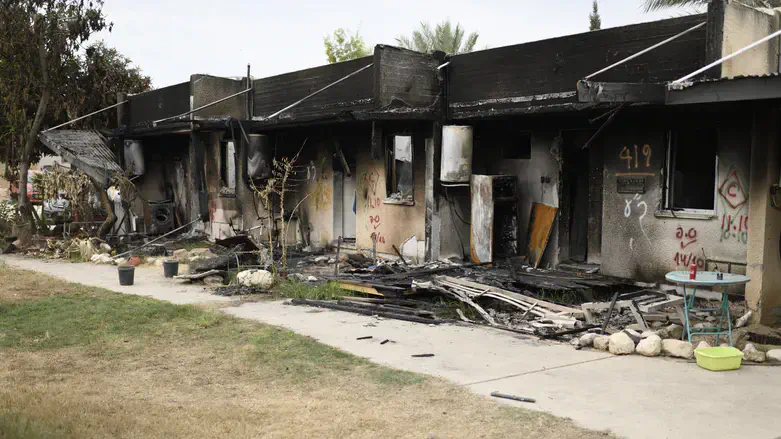
The Supreme Court on Thursday considered a petition by bereaved families seeking to preserve the homes where young residents of Kibbutz Kfar Aza were murdered in the October 7th massacre, rather than relocate some to a nearby memorial site and demolish the rest.
The petition was filed by families of victims from the kibbutz's "Dor Tza'ir" neighborhood. The families are seeking to prevent the neighborhood's demolition and ensure that the murder scene is preserved in its original location as part of the historical memory of the terrorist attack.
The nine petitioners, all relatives of those murdered, challenged a decision to move several buildings from the "Dor Tza'ir" neighborhood to a nearby memorial site and demolish the remaining homes. The families argue that the homes are not merely buildings damaged in the attack, but physical evidence of the murders, fighting and abductions that took place there on October 7th.
The petitioners argue that demolishing the homes or moving them elsewhere would sever their connection to the scene of the events and cause irreversible harm to historical memory. The families are asking the state to examine the possibility of preserving the neighborhood as a national heritage and memorial site before any irreversible steps are taken.
The dispute also centers on the tension between the desire to rebuild Kibbutz Kfar Aza and restore normal life and the families' demand to preserve the neighborhood's remains. The petitioners stress that they do not regard these as conflicting goals. They argue that the location of the "Dor Tza'ir" neighborhood on the edge of the kibbutz would allow it to be preserved in place, with a separate entrance and a buffer zone enabling residents to continue their daily lives.
The families also seek to ensure that their views are heard in decisions about the site's future, including those of bereaved families who are not members of the kibbutz's cooperative association. They argue that the kibbutz members' decision cannot replace an examination of the state's powers to preserve a site of historical and national importance.
In their petition, the families also cite the position of the Heritage Minister, who supports preserving the neighborhood's homes in their original locations. They argue that the necessary professional assessment has not yet been completed and that no reasoned administrative decision has been made on preserving the site. They therefore demand that no buildings be demolished or relocated until that process is complete.
During the Supreme Court hearing, some of the victims' relatives also addressed the justices, presenting their views on the future of the neighborhood where they lost their loved ones. At the close of the hearing, Justice Yael Willner acknowledged the complexity of the issue, describing it as a "heartbreaking situation in every respect." She clarified, "The matter will be decided on judicial grounds," and said a decision would be issued later, after the case file had been reviewed.
Heritage Minister Amichai Eliyahu told Arutz Sheva - Israel National News after the hearing, "We understand the pain of the kibbutz members and support its rehabilitation, but we will not allow the memory of those murdered to be erased. We will not allow anyone to make people forget the atrocities. Even today, there are those who seek to forget them and sit with supporters of terrorism."
He stressed, "Moving the homes will directly harm the memory of the massacre and our narrative internationally in confronting those who deny the massacre. If we do this ourselves, we will empower those who deny the massacre."
He said, "I am acting to preserve the homes under the law, and then legal experts come along and say that my position is not decisive. The result is that the car belonging to Romi Swissa, who was murdered in the massacre, ended up in the hands of a Palestinian scrap metal dealer. This happens because officials pursue policies of their own."
Iris Haim, the mother of Yotam, who was killed, said, "This is not about a personal need of mine to commemorate my son. This is a debate about values: whether preserving evidence of the atrocities is a private or a national matter. We choose to rise to the occasion."
Attorney Dr. Dan Hay, who represents the nine petitioners, said after the hearing that the families want to ensure their voices are heard before an irreversible decision is made about the neighborhood's future.
He said, "Today's Suprme Court hearing is an important step in the families' struggle to ensure that their voices are heard and that the memory of their loved ones is not erased along with the remains of the neighborhood where they were murdered." He added, "The 'Dor Tza'ir' neighborhood in Kfar Aza is not merely a collection of buildings. Its homes bear witness to one of the most devastating events in the history of the State of Israel, a place of profound historical, national and human significance."
Hay stressed that the families are not seeking to prevent the kibbutz's rehabilitation, but to combine rebuilding with preserving the massacre site. He said, "Irreversible decisions about the site's future cannot be made without giving due weight to the position of the families, who carry the pain of loss with them every day."
He added, "The families are not seeking to halt the rehabilitation of Kfar Aza, but to ensure that rebuilding does not come at the expense of memory and commemoration." He said the petitioners expect the court to ensure a process in which the families' views are heard and the possibility of preserving the neighborhood for future generations is examined.
The Supreme Court has not yet ruled on the petition. Justice Willner said a decision would be issued later, after the case file had been reviewed.