

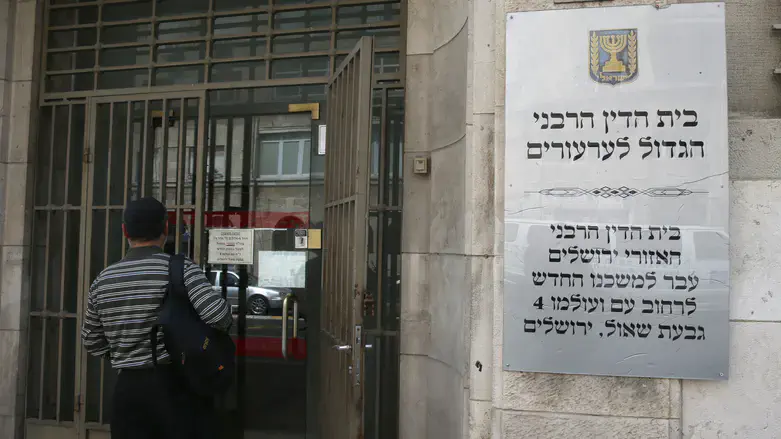
A day after the swearing-in of the 26th Knesset, three major laws on religion and state passed by the outgoing Knesset are at the center of petitions to Israel's Supreme Court. The laws concern the authority of rabbinical courts over child support and civil arbitration, as well as the composition of the assembly that elects the chief rabbis and the Chief Rabbinate Council.
In two of the three proceedings, the Supreme Court has already issued conditional orders requiring the state to explain why the relief sought in the petitions should not be granted. A hearing has been scheduled in the third proceeding.
One of the laws under judicial review is the Religious Courts Arbitration Law, passed in March 2026. The law authorizes rabbinical and Sharia courts to act as arbitrators in civil disputes under religious law, provided all parties consent in writing and subject to restrictions set out in the law.
The legislation came roughly 20 years after the ruling in the "Sima Amir" case, which held that rabbinical courts lacked the authority to conduct civil arbitration without explicit statutory authorization. Now that the Knesset has granted that authorization through legislation, the new arrangement is also facing a Supreme Court petition.
The second law concerns the authority of rabbinical courts to hear child support cases as part of divorce proceedings. In November 2025, the Knesset passed a temporary provision valid for two years, establishing the courts' authority to hear child support claims joined to divorce suits. The legislation followed a Supreme Court ruling that limited their authority in this area.
Supporters of the law argue that it allows divorce-related issues to be handled in a single court, reducing the need for parallel proceedings. Conversely, a petition filed by the organization Israel Hofsheet argues that the law allows a parent to be compelled to litigate in a rabbinical court without their consent.
Last November, the Supreme Court issued a conditional order in the case. It set this coming January as the deadline for submitting response affidavits.
The third law concerns the composition of the assembly that elects the chief rabbis and the Chief Rabbinate Council, which has 150 members: 80 rabbis and 70 public representatives. The amendment established qualification requirements for the 10 rabbis appointed by the chief rabbis, while also requiring at least 30 women among the public representatives.
The petitioners challenging the law argue that the qualification requirements prevent women from being included among the rabbis appointed by the chief rabbis, thereby violating the principle of equality. Last September, the Supreme Court issued a conditional order in this case as well.
The institute Merkaz Yachin, which was involved in drafting all three arrangements, views the petitions as part of a broader dispute over relations between the legislature and the judiciary. Its representatives argue that, in all three cases, the Knesset chose to address issues arising from court rulings through explicit legislation, and that decisive weight should therefore be given to the legislature's determination.
The institute emphasizes that the laws also reflect the status of the religious courts and the Chief Rabbinate as institutions integral to the Jewish identity of the State of Israel.