
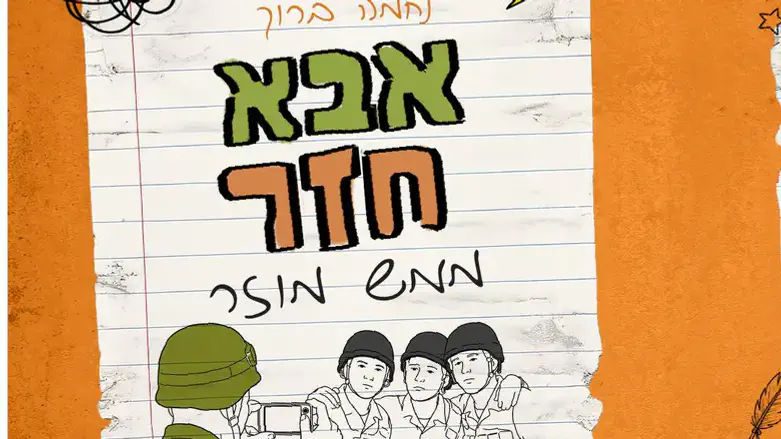
"Dad has returned from reserve duty, but he no longer behaves as he used to. He startles at noises, lashes out in anger, withdraws from his children and sometimes seems as though he is not at home at all." What goes through the mind of a child watching his father change before his eyes?
In her new book, Dad Came Back Acting Really Strange, educational psychologist Nechama Baruch explores the world of children whose parents are coping with post-traumatic stress disorder, and the questions they do not always dare to ask. "Could it be that he doesn't love me anymore? Maybe it's all my fault?," she writes, seeking to give families a shared language for coping with this painful reality.
"The complex reality of the war over the past three years has upended the lives of many families," Baruch writes in the introduction to her book. "Some have lost someone close and dear to them, some have experienced a family member's physical or psychological injury, and some have experienced 'only' hundreds of days of seemingly endless rounds of reserve duty."
Alongside the courage and dedication, there is also a heavy psychological toll. "Courageous soldiers who risked their lives, even when they return physically unharmed, are shattered psychologically." Baruch explains that heightened vigilance, hyperarousal, intrusive thoughts and withdrawal affect not only the person experiencing them but the entire family.
"Post-traumatic stress disorder is a condition in which a person has indeed returned home, but their thoughts and feelings, at least at times, remain on the battlefield," she explains. She says that comparing it to a body part left on the battlefield may help people understand a psychological injury that is invisible but whose effects are felt in everyday life.
One of the book's central concerns is children's inner world. They see the change in their father's behavior but do not know how to interpret it. "What exactly happened to Dad? Why is he behaving differently than usual? Will it be like this forever? Why does every little thing make him jump? Why doesn't he pay attention to me? Could it be that he doesn't love me anymore? Maybe it's all my fault?," Baruch writes, listing the questions troubling children even when they are not spoken aloud.
To allow children to approach the pain without becoming frightened by it, Baruch chose to tell the story through monkey characters. "The story was written using projection to allow the child to choose a comfortable distance from the characters and the story," she explains. This allows children to identify with Little Monkey and Little Monkey Girl, discuss their feelings and gradually, if they are able, talk about the reality in their own homes.
In one of the story's significant moments, Little Monkey is frightened by his father's reaction and immediately blames himself. "It's Dad," Little Monkey said through tears, "I made a loud noise and he almost hit me. It's all my fault. I shouldn't have banged like that."
This sentence expresses one of the emotional risks families face: a child may believe that their behavior caused a parent's outburst. Baruch recommends that parents pause at precisely this moment to ask how Little Monkey felt, what his mother told him and whether he is really to blame for what happened to his father. The central message is that children are not responsible for a parent's PTSD and are not to blame for the parent's reactions.
Perhaps the book's most painful question concerns the future. Little Monkey is not asking for much; he simply wants his dad back. "So will it stay like this forever?" Little Monkey asked quietly. "Will Dad's thoughts never come back here? Will I never be able to show him how good I am at jumping?" The story then describes how "a little tear rolled down from Little Monkey's eyes."
Here, too, Baruch does not seek to offer false promises. Rather than promising that everything will return to the way it was, she offers cautious hope based on treatment, family connection and gradual progress.
"We don't know what will happen," the mother says in the story, "but I've already called our monkey healer to come, and she'll do whatever she can to help Dad. And we'll do what we can to show him that we love him and miss him. And maybe, little by little, his thoughts will come back here."
Baruch emphasizes that "recovery is possible, even if only partial," and that alongside the difficulties, families can develop coping skills and discover new strengths. She suggests that parents talk with their children not only about the possibility that Dad will recover, but also about making gradual progress and learning to carry the family's burden together.
The book is not intended only for children. In the introduction, Baruch offers parents guidance on reading it together, recommending that they first read the story themselves, choose a calm moment and listen to their child's reactions. "With some children, we may remain entirely in the world of imagery because talking about reality would be too difficult," she writes. "It is worth remembering that any engagement with the subject has value, even through projection."
Parents can discuss the characters, ask their child what they liked about the story and what made them angry, draw a picture for Little Monkey and Little Monkey Girl, write them a letter or invent a different ending. Baruch also suggests asking children what might help them feel that Dad loves them, even when his behavior has changed.
At the same time, she stresses that although children can cheer up their father with a small gesture, responsibility for his recovery does not rest on their shoulders. "We don't know how Dad will react, but it's worth reminding him how much we love him," she writes, suggesting ways to strengthen the coping resources of both the child and the family as a whole.
Above all, Baruch seeks to counter the silence and loneliness experienced by many families coping with PTSD. "An important part of coping with this is being able to talk about things and share the experience together," she concludes. "This is a very significant resource in facing the feelings of loneliness and helplessness that many family members experience."