

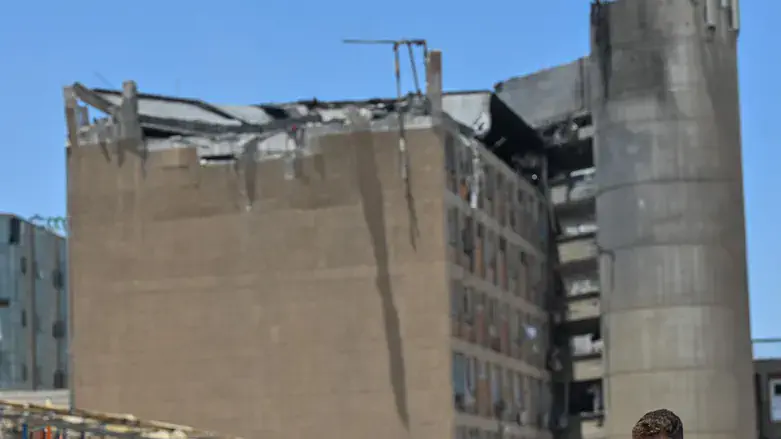
Soroka University Medical Center in Be'er Sheva inaugurated its newly expanded Emergency Department, marking a major milestone in the hospital's recovery following the October 7, 2023, Hamas massacre and the Iranian ballistic missile strike that directly hit the medical center in June 2025.
The hospital, operated by Clalit Health Services, Israel's largest health organization, serves as the primary medical center for the Negev and plays a critical role in providing emergency medical care to residents of southern Israel.
The newly inaugurated expansion increases the size of Israel's busiest emergency department by approximately 50%, adding 2,000 square meters, more than 40 treatment stations, and two additional trauma bays.
With the expansion completed, the department will have more than 110 treatment stations and eight trauma bays, significantly increasing its ability to treat patients during routine operations and respond to mass-casualty incidents.
The inauguration carries particular significance in light of the extraordinary challenges Soroka has faced over the past three years.
On October 7, 2023, as Hamas terrorists carried out their massacre in southern Israel, Soroka's emergency department treated 674 wounded civilians and security personnel in a single day, many suffering from critical and life-threatening injuries.
Throughout the subsequent Swords of Iron war, the hospital continued serving as a frontline medical center, treating wounded soldiers and civilians while maintaining essential medical services for the population of the Negev.
In June 2025, Soroka itself became the target of an Iranian ballistic missile strike, which caused extensive damage to the hospital and disrupted parts of its operations.
Despite the destruction, the hospital continued its recovery and development, with the expanded emergency department representing an effort not merely to restore damaged infrastructure but to strengthen its capabilities for future emergencies.
The project was made possible through the support of the Kirsh family, through Kirsh Philanthropies, in partnership with UJA-Federation of New York, Keren Hayesod, Clalit Health Services, and the Municipality of Be'er Sheva.
Among those participating in the inauguration ceremony was Yair Avital, a resident of Kibbutz Be'eri and commander of its local civilian security team, who was seriously wounded during the October 7 massacre and treated at Soroka.
Avital delivered an emotional account of the care he received after being evacuated to the hospital.
"When I arrived at Soroka, for the first time after a day of unimaginable suffering, I received medication for the pain," he recalled.
"After what I had experienced, I encountered kind eyes, enormous hearts and genuine patience. You never gave up on me. For so long, you continued listening and helping me find my family."
Avital praised the hospital's medical teams for their extraordinary cooperation under the most difficult circumstances.
"I witnessed capabilities I had never seen in any other system in the country, all through the extraordinary cooperation and shared understanding among the medical teams. They do everything they can for every single patient, even under impossible conditions."
Prof. Shlomi Kodesh, Director General of Soroka University Medical Center, emphasized the importance of expanding the hospital's emergency capabilities.
"The emergency department is where life-saving decisions are made, where just a few minutes can change the course of a person's life," Kodesh said.
"A protected and expanded emergency department is not simply a promise of future preparedness. Its importance has already been demonstrated in reality and has been felt by both our patients and our medical teams."
Kodesh thanked the donors who made the expansion possible, stressing that the project is part of a broader effort to rebuild and strengthen the medical center.
"The generosity of Francis and Nathan Kirsh, through Kirsh Philanthropies and UJA-Federation of New York, made this project possible. We are deeply grateful for their partnership and their confidence in Soroka and the people of the Negev, and to our partners at Keren Hayesod."
"Construction and development continue across Soroka, with many more projects ahead. We are building the capabilities and infrastructure needed to secure a stronger future for this medical center," he added.
Maj. Gen. (Res.) Yohanan Locker, Chairman of Clalit's Board of Directors, described Soroka as a strategic national asset.
"Soroka is a strategic asset for Clalit and for the State of Israel, in both routine times and emergencies," Locker said.
"The resilience of a healthcare system is also measured by its sustained investment in infrastructure, service development and medical excellence, day after day."
He added that the expansion reflects Clalit's commitment to ensuring Soroka continues providing advanced medical care to the people of southern Israel.
Outgoing Health Ministry Director General Moshe Bar Siman Tov recalled the extraordinary challenges faced by the hospital on October 7 and throughout the war.
"October 7 was the greatest test that any hospital and healthcare system in Israel had ever faced," he said.
"Throughout the Swords of Iron war, Soroka received more wounded patients than any other hospital, many of them in critical and life-threatening condition."
Bar Siman Tov also praised the hospital's staff for their dedication and cooperation across different sectors of Israeli society.
"Beyond its medical professionalism, I witnessed here a model of care that sees the whole person. Soroka is also an example of the kind of society we want to see in Israel, where people from every part of society work together, and that partnership is an inseparable part of their work."
Prof. Dan Schwarzfuchs, Deputy Director of Soroka and Head of its Emergency Medicine Department, emphasized the responsibility of medical teams to provide patients with both professional treatment and a sense of security.
"For many patients, the emergency department is their first point of contact with the hospital. They arrive in moments of pain, anxiety and uncertainty, entrusting us with their health and sometimes their lives," he said.
"Our responsibility is not only to provide the highest standard of medical care, but also to build a sense of security and trust."
Schwarzfuchs concluded by emphasizing the human dimension of emergency medicine.
"That trust is renewed every day, through every encounter, thanks to our people, their professionalism, teamwork, commitment and compassion. At the heart of everything we do is a simple principle: treating every person as a human being, first and foremost."
The expanded emergency department represents another step in Soroka's recovery from the destruction of war, strengthening the hospital's ability to provide life-saving treatment to the residents of the Negev during both routine medical emergencies and national crises.