
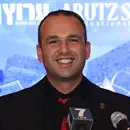
Outgoing Constitution, Law and Justice Committee chairman MK Simcha Rothman (Religious Zionism) believes the chances of forming a unity government are diminishing and has sharply criticized Gadi Eisenkot's conduct.
In an interview with Arutz Sheva, he criticized the opposition bloc's cooperation with the Arab parties, questioned Avigdor Liberman's shift in positions on the judicial system, and addressed plans to repeal laws he advanced during his tenure as committee chairman.
Addressing contacts between Likud and the Yashar party and Eisenkot's sharply worded statement against Prime Minister Benjamin Netanyahu, Rothman said the prospect of reaching political agreements was becoming more remote. Speaking about the chances of a unity government, he said, "I think they are diminishing, unfortunately. I think there is a very, very serious lack of responsibility in the way Eisenkot speaks."
Rothman also criticized Eisenkot's statements on social media. He said, "Incidentally, it looks as though someone is writing his tweets for him. I really cannot understand what is gained from this conduct". He said anyone seeking agreements with political opponents should behave differently, adding, "I think someone who wants to achieve unity and agreement speaks differently and acts differently."
Despite his doubts about the prospects of such a move, Rothman called on opposition MKs to join a unity government and avoid relying on the Arab parties. He said cooperation with those parties to secure a majority in Knesset votes crossed a red line for him.
He argued, "There is no doubt that anyone willing to cooperate with parties of terror supporters can get things done in the Knesset in a way that, in my view, is of course illegitimate, because these are illegitimate parties". He added that, in the past, there had been an understanding not to rely on these parties to decide parliamentary battles.
Rothman sharpened his criticism when asked whether the right-wing bloc had lost control of the Knesset in light of the votes and appointments being advanced by the opposition bloc. He argued, "The numbers certainly speak for themselves. Once someone is willing to cooperate with 19 Knesset seats whose declared goal is to destroy the State of Israel, certainly as a Jewish state, as the state of the Jewish people, all boundaries have been crossed". In such a situation, he said, "there could certainly be a loss of control here."
He then appealed to opposition MKs to join an effort toward national unity. He said, "Anyone who understands this needs to come forward and join the call for unity, rather than cooperate with enemies."
Alongside his criticism of the parliamentary moves, Rothman addressed the opposition bloc's intention to repeal or amend laws he advanced as Constitution, Law and Justice Committee chairman. Rather than expressing the concern one might expect from the person who led the legislation, Rothman presented the efforts to repeal it as evidence of his work's impact.
He said, "First of all, I can say that it is very, very flattering that yesterday's opposition-we do not know who will be in the coalition and who will be in the opposition in this Knesset-understands that the most important, most urgent and most pressing thing is to fix, from their perspective, or ruin, from mine, the things I did."
He said the very fact that his political opponents wanted to change the legislation showed that it had brought about significant change. He added, "That means my work is definitely having an impact on the State of Israel. There is a consensus on the other side, among the opponents of the national camp, that my work has indeed done things in this country that, from their perspective, must be fixed."
Rothman expressed particular bewilderment at the conduct of politicians who, he said, had previously taken firm positions in favor of changes to the judicial system but now sought to repeal laws he had advanced. He focused on Yisrael Beytenu chairman Avigdor Liberman, who he said had supported even more far-reaching changes over the years than those Rothman himself had proposed.
He said, "Take Liberman, for example, on the appointment of judges, on the powers of the Supreme Court, on striking down laws, and on splitting the role of the attorney general. Over the years, they have put forward positions further to the right than mine, and suddenly Yair Golan is leading them by the nose".
Rothman added that he could not understand the gap between Liberman's past positions and the moves he was now advancing. He said, "I cannot understand this conduct. We have also heard other things from Liberman, but we are all waiting to try to understand what lies behind Avigdor Liberman's promises to himself, his voters and the State of Israel".
Toward the end of the interview, Rothman returned to the issue of a unity government, stressing that the national camp had sought agreements with its political opponents even when it held a Knesset majority. He said, "We spoke this way even when we held the power. Even when we had a large majority of 64 and 68, our hand was always extended to them". He concluded, "But the ledger is open and the hand is recording, as the saying goes".