
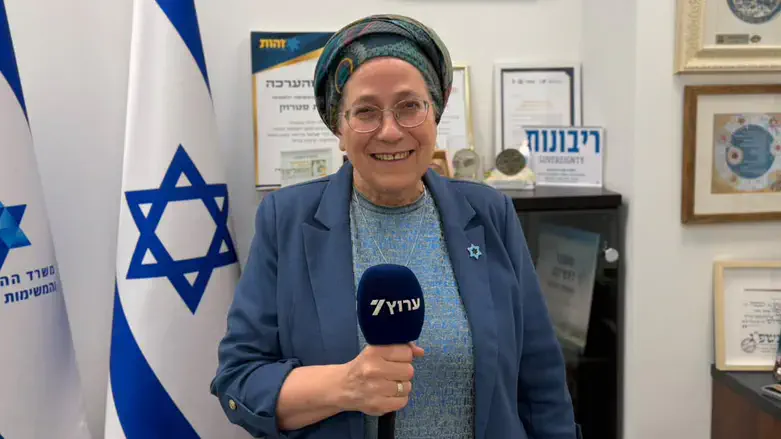
Minister and security cabinet member Orit Strock (Religious Zionist party) called for frank talks on forming a unity government in an interview with Arutz Sheva-Israel National News, making clear that such a move would also require compromises on her part. However, she is not committing to joining the resulting government: If the agreements cross her red lines, she may remain outside it.
"The compromise they reach may be one that I, for example, could not live with under any circumstances. Then I would find myself outside that government". She adds, "But first, everyone needs to sit down together and talk, and try to arrive at some kind of government that can address this nation's needs,"Strock says.
She is also bringing that call to the tent encampment set up by MK Elisha Medan (Likud) in Jerusalem. For her, the journey there brought back memories of a Saturday night three years ago, when she heard that he had been seriously wounded in battle in Gaza and rushed to the hospital. She recalls his mother, Ruti, standing by his side, and the words she offered her in an effort to reassure her, "He is a strong young man; he will be all right."
Strock says, "Look, three years have passed. He is a strong young man, and he is all right, and he is calling us all to order". She adds, "That is what came to mind as I made my way to him and sat down beside him. He really is calling us all to order, and rightly so."
Strock does not underestimate the distance between the political camps. She says their positions on some issues are poles apart, and bridging those differences will be difficult. In her view, however, the election results oblige elected representatives to try: She argues that neither bloc has a majority to form a government without relying on parties she rules out as partners.
She says, "We must at least make this effort, and do so honestly, sincerely and genuinely." In her view, a government relying on the votes of those she describes as Israel's enemies would pose "a genuine existential danger," and she therefore regards efforts to reach agreements as a national duty.
Asked whether she herself would be willing to compromise, her answer is unequivocal: "Of course." She describes the gap between her aspirations in Judea and Samaria and Gaza and the positions of those on the other side of the political spectrum, acknowledging that a joint government would require her to compromise.
However, she declines to answer a question about a rotation arrangement with Gadi Eisenkot, particularly the possibility of his serving first. She says, "My experience, and unfortunately I have extensive experience, teaches me that any negotiation conducted through the media is destined to fail." The details, she stresses, must be worked out behind closed doors, without microphones or leaks.
The demand to form a government without Netanyahu does not change her guiding principle either: "The rhetoric of boycotts must be set aside." She says the disagreements themselves and possible areas of agreement should be addressed first, followed by the allocation of posts. She explains, "I am approaching this from a position of not wanting to kill the initiative. I want it to succeed."
Alongside her call for talks, Strock sharply criticizes Liberman and Matan Kahana over the possibility that they could be appointed to Knesset posts with the support of the anti-Zionist Arab parties. She recalls remarks Kahana previously made in an Arutz Sheva interview opposing a partnership with Ra'am, arguing that they contradict his current desire to become Knesset speaker with the support of people he said should not serve in it.
Later in the interview, she also addresses the haredi parties' anger toward Likud and the Religious Zionist Party. Strock expresses understanding for their disappointment but makes clear that her position on military conscription differs: "In our community, there is no such thing as everyone who studies Torah not enlisting."
She recounts conversations she held as a member of the committee that appoints rabbinical judges, when she called to inform judges of their selection and found them serving in uniform in Gaza and Syria. She says, "It truly filled me with pride in the study halls from which our Torah scholars come." However, she stresses that even a broad-based government would need to listen to the haredim and address the issues important to them.
Toward the end of the interview, Strock is asked about the possibility of renewed war with Iran. She declines to discuss security cabinet deliberations but warns that Iran has not abandoned its ambition to destroy Israel and continues to arm itself and build up its strength.
Responding to claims that political considerations are influencing the handling of the Iranian threat, she criticizes Eisenkot, who she says is well acquainted with the security cabinet's work from his time as IDF chief of staff and as a minister. She says, "All the heads of the security agencies must be able to speak and express their views as clearly as possible, and they are listened to, but ultimately it is the political leadership that decides. Without that basic principle, Israel has no ability to deal with the truly existential threats we face."