

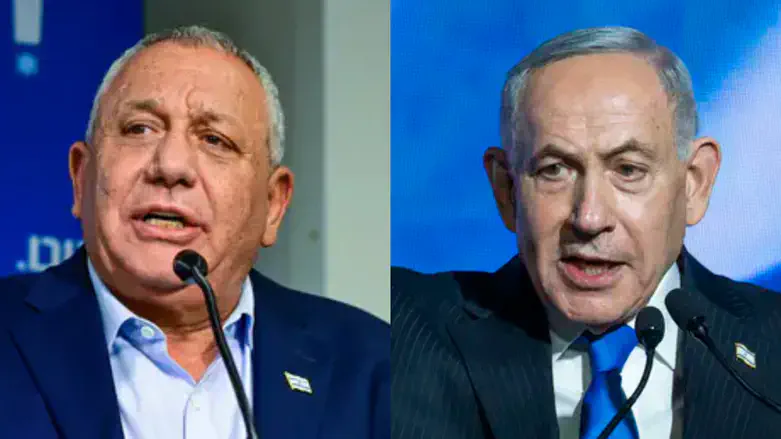
Yashar party chairman Gadi Eisenkot is expected to offer Prime Minister Benjamin Netanyahu and the Likud party a place in a national unity government under his leadership, without a rotation agreement for the premiership, Channel 13 News reported.
Eisenkot, who holds the mandate to form the next government, intends to pursue an arrangement that would allow Netanyahu to join the government and focus on diplomatic affairs, but is unwilling to relinquish the position of Prime Minister.
As part of the negotiations, Yashar is expected to explore the possibility of offering Netanyahu a special role dealing with diplomatic matters. According to the report, the proposal could also include arrangements concerning an official residence, security, and personal matters.
Alongside its planned approach to Likud, Eisenkot's party is also expected to reach out to the Religious Zionist Party, led by Bezalel Smotrich, in an effort to establish a broad foundation for a unity government.
Despite a willingness to consider compromises during negotiations, sources close to Eisenkot have made clear that the identity of the next Prime Minister is not negotiable.
"We will agree to compromises, but not on the question of who will be Prime Minister."
The report follows a meeting between Eisenkot and Netanyahu on Thursday, after which the Prime Minister issued a public call on Saturday evening for the establishment of a national unity government.
Netanyahu said the meeting had reinforced his belief in the need for a broad government that would include parties supporting Israel's existence as the nation-state of the Jewish people.
He argued that, given the security challenges facing Israel, a narrow government or one dependent on the support of individuals he describes as supporters of terrorism would be insufficient.
"A narrow government, or a government that relies on supporters of terrorism, will not be able to meet this enormous challenge," Netanyahu said.
The Prime Minister addressed Eisenkot directly, calling on him to begin negotiations without preconditions and set aside political disagreements.
"Instead of trying to establish a fragile and dangerous government, let us enter a room without preconditions, put aside all disagreements and boycotts, and reach agreements for Israel's security and future, including on the issue of military enlistment, which can be resolved together with representatives of the haredi community," he declared.
Netanyahu also cited examples of cooperation between Israelis from different political camps, including Elisha Medan and Elyasaf Peretz, as well as Talik Guili and Shira Shapiro.
He concluded by calling for the establishment of what he described as a "Government of Hope."
"The response to those who deliberately walked out during the singing of Hatikvah is to establish the Government of Hope, a national unity government," Netanyahu said.
Eisenkot, for his part, sharply criticized Netanyahu's statement, arguing that the public call for negotiations misrepresented the situation, since a meeting between the two parties' negotiating teams had already been scheduled for the following day.
"Another spin," Eisenkot wrote in response. "Netanyahu knows perfectly well that such a meeting has already been scheduled for tomorrow between the negotiating teams of Yashar and Likud."
He went on to accuse Netanyahu of publicly promoting unity while, in his view, continuing to deepen political divisions through his conduct.
"This is the latest bluff: Netanyahu calls for negotiations after they have already been arranged, claims he wants unity, but disgraces an official state occasion at the Knesset and continues to divide and incite as if there were no tomorrow," Eisenkot wrote.
He concluded: "Nice try, but these tricks don't work on me, and they don't work on the citizens of Israel either."