
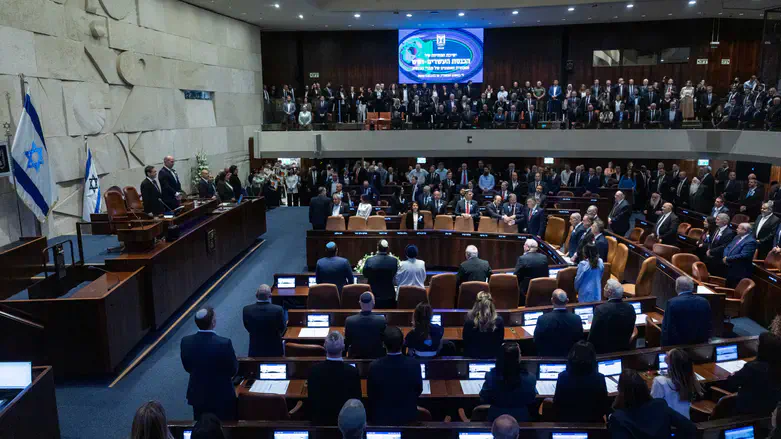
The disqualification of Ra'am and the Joint List by Israel's Central Elections Committee (CEC) and the reversal of those decisions by the Supreme Court exposed a contradiction that has again brought Israeli government to a standstill: the democratic institution representing the collective spirit of the Israel is eclipsed by an undemocratic, unrepresentative Supreme Court.
The Israeli system of government, despite itsinadequacies, provides an incredibly comprehensive reflection of Israeli society in all itsdiverse, tribal expressions. Knesset elections function as a spiritual census, measuring the relative strength of competing and complementary impulses within the Hebrew consciousness.
"This Holy Spirit does not depart from the finest among the nation. It stirs within all those of an upright heart, in a particular measure and degree, according to each person's individual capacity… Even in times of corruption and sin, the Divine Light is never extinguished." (Rabbi Avraham Yitzhak HaKohen Kook zt"l, Orot HaTehiya 69)
The Knesset is thereby a temporal reflection of Israel's collective spirit: its holy, eternal spirit (Klal Yisrael) expressed through the present generation and distilled by democracy into a governing body and instrument of sovereignty (malkhut).
“All appointments to government offices in Israel through elections, in which the majority of the people determine the outcome, possess validity and authority… A government council chosen through proper elections would possess authority in all matters concerning the governance of the nation, equivalent to the authority possessed by the King of Israel." (Rabbi Shaul Yisraeli, zt"l, Amud HaYemini 7)
This holy, democratic legitimacy extends to institutions established through Knesset legislation. This includes the Knesset Elections Law of 1969 which formed the Central Election Committee (CEC) and the 1985 amendment to Basic Law: Knesset which authorized the CEC to disqualify lists and candidates on the basis of
“(1) negation of the existence of the State of Israel as a Jewish and democratic state;
(2) incitement to racism;
(3) support for armed struggle by a hostile state or by a terrorist organization against the State of Israel."
With this authority, the CEC voted18-5 to disqualify Ra'am and the Joint Listfrom this year's elections, while rejecting similar petitions against the Democrats and Otzma Yehudit. This judgment reflected the collective spirit of Israel: parties identifying with enemy populations, accusing Israel ofgenocide, defendingHamas andmourning its fallen could not legitimately claim to represent that same spirit.
The Supreme Court overturned these decisions. Unanimously.
The CEC banned Ra'am and the Joint List because it is a democratic body founded in Knesset legislation and a reflection of Israel's collective spirit, while the Supreme Court overturned these bans because they are an undemocratic body with no basis in Knesset legislation that does not reflect Israel's collective spirit.
Had the CEC's decisions stood, Ra'am and the Joint List would have been barred from the political arena. Instead, the Supreme Court's intervention allowed them to participate, contributing to the 19 gridlocking mandates belonging to parties that coordinate withHamas and thePalestinian Authority.
Despite the frustration, Israel’s democratic system leaves little more to be desired. We have a system that is holy, a system which expresses the collective spirit of Israel and is demonstrably capable of defending itself from atrophy and subversion, if not for an antidemocratic and detached judiciary which has usurped sovereignty.