

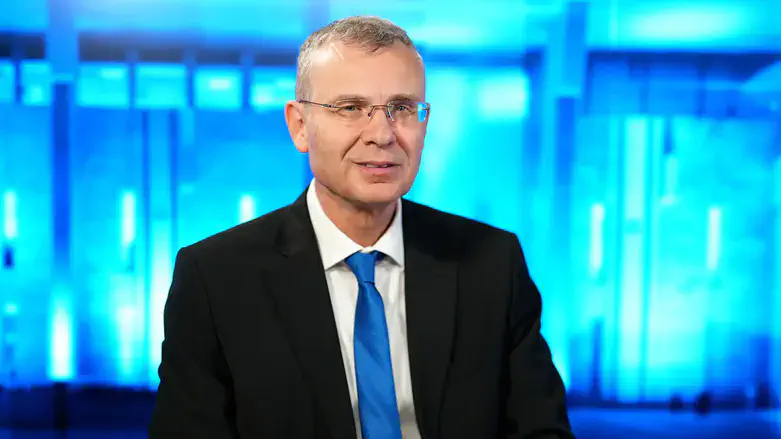
Justice Minister Yariv Levin says Israel has a historic opportunity to advance judicial reform and extend sovereignty over parts of Judea and Samaria, arguing that the next government must take advantage of the remaining two years of US President Donald Trump's term.
In an interview with Arutz Sheva - Israel National News ahead of the upcoming Knesset elections, Levin discussed his efforts to reshape Israel's judicial system, his contentious relationship with Supreme Court justices, the divisions within the right-wing political camp and the future of Israeli communities in Judea and Samaria.
Levin insisted that years of protests and political pressure had not weakened his determination to complete the judicial reforms he initiated. Asked whether demonstrations outside his home in Modi'in, protests during the traditional mourning period following his father's death or demonstrations against him at Bloomfield Stadium had ever made him consider giving up, he answered emphatically.
“Absolutely not," Levin said. “Anyone who wants to hold leadership positions and has to deal with very difficult events and very difficult decisions needs resilience, and must not break or fall apart over everything. It's mainly difficult for the family, which didn't choose this. I, at least, made the choice I made."
Levin said attacks from political opponents had not deterred him, but criticism from within his own political camp had been more painful.
“I have no expectations from the other side," he said. “They won't deter me in any way from doing what I believe in."
He accused some of his critics of creating unrealistic expectations about how quickly the judicial system could be transformed. According to Levin, commentators and politicians had presented seemingly simple solutions to complex legal problems, then attacked him when the promised results did not materialize immediately.
He also revisited the government's decision to suspend judicial reform legislation in March 2023, a move he said he had opposed. Levin maintained that he had warned coalition leaders that halting the process would not bring about an agreement with opponents of the reform but would instead be interpreted as weakness and invite further pressure.
“I did not receive the necessary backing, not from some of the party leaders, and certainly not from some members of Knesset from various coalition factions," he said.
Levin described the suspension of the legislation as “a demonstration of weakness that cost us dearly." He argued that a government elected to implement a particular policy should not abandon it because of protests and public pressure.
Nevertheless, he rejected the claim that judicial reform had failed. He listed several measures he presented as achievements of his tenure, including changes to the Judicial Selection Committee that are due to take effect in the next Knesset, the appointment of numerous lower-court judges, the appointment of a commissioner for complaints against judges and changes to contract interpretation law.
Levin also cited a requirement for defense counsel to be present during interrogations of minors and people with disabilities. He claimed that more than 150 judges appointed or promoted during his tenure would not previously have advanced through the judicial system, adding that approximately one-third of Israel's judges had been appointed or promoted during his time in office.
His principal unfinished objective, however, remains changing the composition of the Supreme Court.
Levin said he expects 10 positions on the Supreme Court to become vacant during the next Knesset's term, creating what he described as an exceptional opportunity to reshape the court. He argued that the justices would eventually find it more difficult to block his preferred candidates as the number of serving judges declines.
In discussing the dispute over judicial appointments, Levin revealed what he said were messages conveyed to him by Supreme Court justices during negotiations over candidates.
According to Levin, the justices indicated that they would accept appointments that could be presented publicly as conservative victories, provided the candidates were acceptable to them. He claimed they were unwilling to approve the appointments of legal scholars such as Dr. Aviad Bakshi and Dr. Biton.
Levin described the arrangement he said had been proposed: the justices would initially oppose certain candidates and later agree to appointments that would allow him to claim a political achievement, without fundamentally changing the court's character.
“You take the political credit, and we will protect our Supreme Court," Levin said, recounting the message he said he received.
He added that when he insisted on appointing candidates the justices opposed, they made clear that they were prepared to exercise their veto power and wait for a different justice minister to take office.
“We are on the verge of completing this enormous undertaking," Levin said.
The justice minister also warned that divisions among right-wing parties could undermine the chances of forming a government capable of continuing his judicial reforms. He criticized smaller parties running independently of Likud and other coalition factions, arguing that they risked wasting votes by failing to cross the electoral threshold.
“I don't know of any trick like that, where you strengthen someone by voting for somebody else," Levin said in response to arguments that voting for smaller parties could help Prime Minister Benjamin Netanyahu. “If you want to strengthen Netanyahu, vote for Likud." He also criticized the approach of new political contenders who present themselves as capable of replacing existing leadership and solving longstanding problems on their own.
Levin contrasted that approach with the political alliance between Religious Zionist Party chairman Bezalel Smotrich and Moshe Feiglin, which he praised as an example of politicians overcoming differences to prevent votes from being lost.
Turning to the broader political agenda, Levin said the next government would need to engage in significant diplomatic discussions with Trump. He argued that Netanyahu's political strength would affect his ability to advance Israel's objectives in Washington.
Levin identified three issues that he believes make the upcoming elections particularly consequential: the Iranian threat, the future of Israeli communities in Judea and Samaria, and the composition of the Supreme Court.
On Iran, he said cooperation between Netanyahu and Trump could help Israel confront the Iranian nuclear threat. He also raised the possibility of a strategic shift in relations with Iran if its regime were to change, presenting this as a potential future development rather than an accomplished fact.
Regarding Judea and Samaria, Levin cited what he described as substantial achievements in expanding Israeli communities, including the establishment of 104 new communities, alongside infrastructure development and the strengthening of existing towns.
He said the remaining two years of Trump's presidency presented an opportunity to advance further measures, including extending Israeli sovereignty over at least some parts of Judea and Samaria.
“I think there is definitely a possibility that toward the end of President Trump's term, we will be able to advance the application of sovereignty," Levin said.
He warned that losing this opportunity because of a change of government in Israel would be a serious mistake. Levin also criticized the previous government's policies toward construction in Judea and Samaria, warning against a return to restrictions on building and community expansion.
Levin also launched a sharp attack on law enforcement authorities over the ongoing criminal trial of Netanyahu. He called for the proceedings to be canceled and for a government-appointed commission of inquiry to investigate the conduct of investigators, prosecutors and other officials involved in the cases.
“This trial must end. It must be canceled," Levin said.
He claimed that testimony presented in court had revealed serious misconduct by law enforcement officials and criticized the judges overseeing the proceedings for what he described as their failure to respond adequately to the allegations. Levin argued that a commission of inquiry would provide a way to examine the conduct of those involved in the investigations and indictments.
He maintained that the extensive powers held by law enforcement authorities required transparency, restraint and integrity, warning that their improper use undermines democratic institutions.
Despite the political and personal pressures he described, Levin said he continued to receive encouragement from members of the public who supported his efforts. He said that support reinforced his determination to return to the Justice Ministry and complete the changes he had begun.
“I am very determined to complete this mission," he said.
Levin concluded by urging voters to participate in the elections and support parties that would continue the policies he advocates.
“This is the time for responsibility. This is the time to go out and vote," he said.