
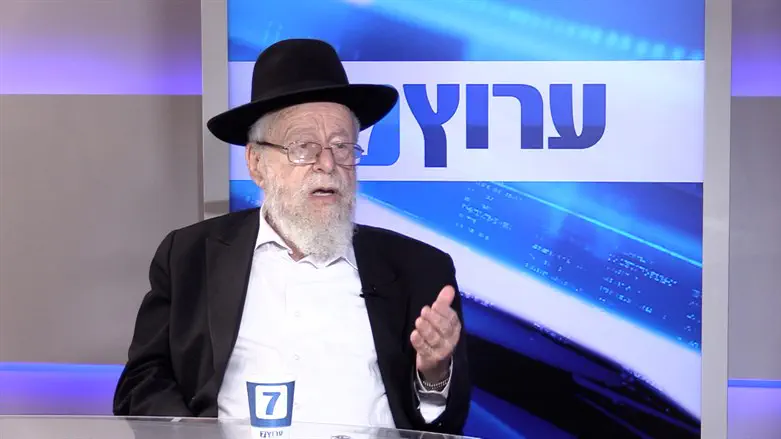
In response to a halachic question submitted to him, Rabbi Dov Lior published a detailed ruling addressing the wording used to conclude blessings during the cantor's repetition of the Amidah in prayers held on the Temple Mount.
The question arose following the practice of some worshippers who alter the conclusion of the blessings by adding the words "Blessed is the Lord, God of Israel," while responding "Blessed be the name of His glorious kingdom forever and ever" instead of the customary "Amen."
Rabbi Lior ruled that this practice should not be followed today, as long as the Holy Temple has not yet been rebuilt.
In his response, Rabbi Lior revealed that approximately two years ago, he asked his son, Rabbi Elkana Lior, to conduct a comprehensive halachic examination of the issue.
According to Rabbi Lior, his son wrote a well-founded and thoroughly reasoned article demonstrating, based on Rashi and other early rabbinic authorities, that the practice of changing the wording of the blessings applied specifically during the period when the Holy Temple stood.
Rabbi Lior wrote, "In my humble opinion, he is absolutely correct in his halachic analysis and has arrived at the truth. It is surprising that Rabbi Goren, in his book (The Temple Mount, Chapter 31), did not address this aspect at all."
The halachic analysis is based, among other sources, on Rashi's commentary on Tractate Ta'anit (15b), where he explains the Mishnah discussing the special wording of blessings on the Temple Mount:
"That is, when the Holy Temple stood, when prayers were recited on the Temple Mount."
According to the explanation presented by Rabbi Lior, the special wording was connected to the manifestation of the Divine Presence when the Holy Temple stood and to the pronunciation of God's explicit Name in the Temple courtyard.
Although Ezra instituted this wording at the Eastern Gate as well, outside the Temple courtyard, the enactment was connected to the existence of the Temple and the gate's location opposite the courtyard and the Holy of Holies.
Rabbi Lior therefore concludes that, in the absence of the Holy Temple, the customary wording of the blessings should not be changed.
Rabbi Lior also addressed the claim that his previous participation in an afternoon Mincha prayer service on the Temple Mount, during which worshippers altered the wording used to conclude the blessings, indicated his approval of the practice.
The rabbi rejected this interpretation, clarifying, "Therefore, none of my previous involvement with this issue should be regarded as a practical halachic ruling."
In this context, he quoted the Talmud in Tractate Bava Batra (130b):
"One does not derive practical halacha from a teaching or from an observed action until it is explicitly stated that this is the halacha to be followed in practice."
Rabbi Lior emphasized that his mere presence at a particular prayer service does not constitute a halachic ruling or an endorsement of the customs observed during that service.
After presenting his halachic reasoning, Rabbi Lior issued an unequivocal ruling:
"I fully endorse Rabbi Elkana's halachic analysis. Therefore, in my humble opinion, the practical ruling today is that during the cantor's repetition of the Amidah in prayers on the Temple Mount, the customary wording used to conclude the blessings in Jerusalem and throughout the Land of Israel must not be changed until the Holy Temple is rebuilt."