

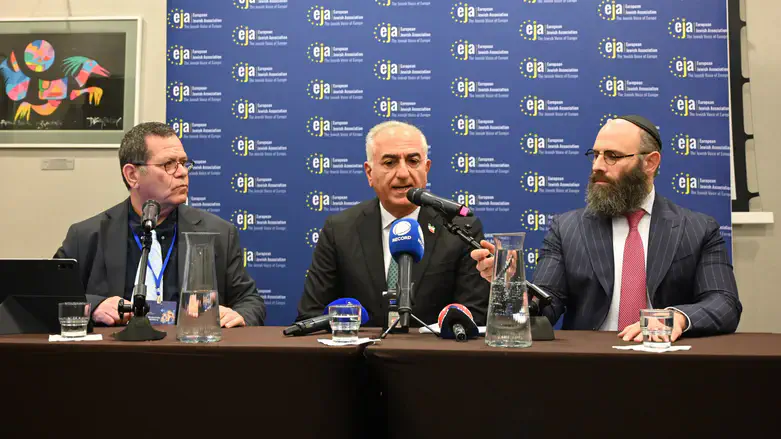
Amid growing antisemitism, violent unrest and political polarization across Europe, Rabbi Menachem Margolin, Chairman of the European Jewish Association (EJA), called on European governments to move beyond Holocaust commemorations and take concrete action to protect Jewish communities.
Speaking at the EJA's annual conference in Krakow, Poland, Margolin criticized the gap between European leaders' pledges to remember the Holocaust and their response to contemporary antisemitic threats. He urged governments to enforce laws against intimidation, incitement and violence, regardless of the perpetrators' political or ideological affiliations.
The conference, held under the theme “Honoring the Past, Safeguarding the Future," brought together more than 120 lawmakers, diplomats and Jewish leaders ahead of a visit to Auschwitz-Birkenau.
Participants included Iranian Crown Prince Reza Pahlavi, Baroness Claire Fox, Belgian parliamentary Vice-President Florence Reuter, Cypriot Democratic Party President Nikolas Papadopoulos, German MP Cornell Babendererde, Swedish MP Muharrem Demirok and Israeli Ambassador to Poland Yaakov Finkelstein.
Opening the gathering, Margolin challenged European governments to demonstrate that the lessons of the Holocaust had translated into meaningful protections for Jewish citizens.
“How can Europe claim to have learned the lessons of Auschwitz if Jews are once again afraid to be visibly Jewish in European cities? You can refuse to allow hatred to be excused as activism, intimidation to be dismissed as protest, or violence to be justified by political grievances. And above all, you can make clear that the safety of Jewish citizens is not negotiable. Not when the streets are calm. Not when the streets are burning."
Margolin called for stronger political support for police, prosecutors and universities confronting antisemitism, whether originating from the far right, the far left or religious extremism.
He emphasized that criticism of Israel must not be used to justify threats against European Jews and that freedom of protest does not extend to intimidation or incitement.
Iranian Crown Prince Reza Pahlavi joined Margolin for a press conference examining Iran's activities, European policy and antisemitism in the context of recent elections in Israel and the United States and upcoming elections across Europe.
Pahlavi warned that the Iranian regime posed an increasingly serious threat beyond the Middle East and urged European governments to adopt stronger measures against Tehran.
“The Iranian regime is no longer just a threat to Israel or the Iranian people. It is now a direct threat to Europe’s security. The time for resolutions and condemnations is over. European governments must take action: shut down the regime’s embassies, expel its diplomats and target its illicit funds. Appeasement has failed. The free world must stop giving in to the regime’s blackmail and stand with the Iranian people fighting for freedom."
Israel's Ambassador to Poland, Yaakov Finkelstein, highlighted the importance of combining Holocaust remembrance with education and effective legal measures against hatred.
“Auschwitz stands as a chilling reminder of where hatred can lead. While we cannot change the past, we have a responsibility to shape the future. Combating antisemitism and xenophobia requires education, both formal and informal, alongside remembrance, effective legislation and law enforcement. These are essential to ensuring that the lessons of history are never forgotten."
The conference also examined the spread of antisemitism online, including the role of social media platforms and the potential misuse of artificial intelligence.
Jeff Bullwinkel, Microsoft's Vice-President for Europe, the Middle East and Africa, described technology as both “a very powerful tool" and “a very powerful weapon," outlining the company's efforts to test artificial intelligence systems and implement safeguards against hateful content.
Edo Haveman, Meta's Director of Public Policy for Benelux, discussed the company's approach to identifying coded antisemitism, including instances in which the term “Zionist" is used in place of “Jew" to promote antisemitic conspiracy theories.
The discussions also addressed the deteriorating sense of security among Jewish communities in several European countries.
Ellen van Praagh, Chair of the Netherlands' Interprovincial Rabbinate, described her personal experience of rising antisemitism since the October 7 attacks.
“Since October 7, I have not felt safe as a Jew in the Netherlands. In my hometown, a Jewish exhibition was cancelled because of events in Israel, while Israeli students face exclusion and antisemitic hostility is increasingly visible on our streets. This is the reality of Jewish life in Europe today. We must be able to live openly and proudly as Jews, without fear."
Delegates are scheduled to visit the Auschwitz-Birkenau memorial on Tuesday for a ceremony featuring prayers, candle lighting and wreath laying.
Ahead of the visit, Margolin urged participants to return to their respective countries prepared to demand stronger government action against antisemitism.
“Europe must stop asking Jews to live with fear and start demanding that those who threaten them live with consequences. Never Again is not a memorial slogan. It is a government responsibility."