

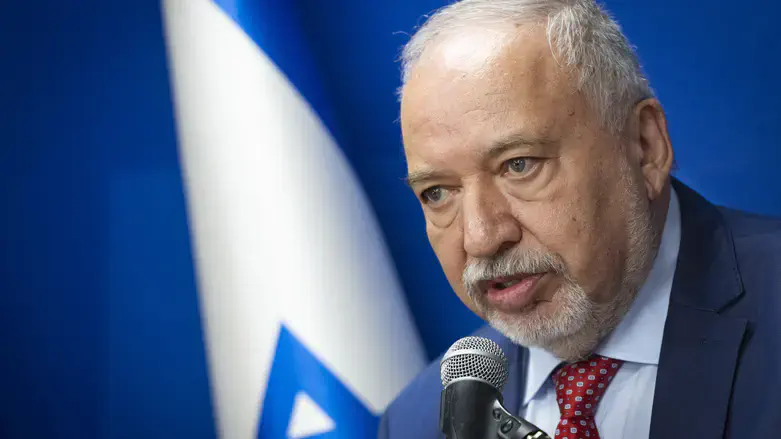
Yisrael Beytenu chairman MK Avigdor Liberman responded to criticism of negotiations with the haredi parties, clarifying that his willingness to reach compromises does not mean abandoning his principles, foremost among them the conscription of haredi men into the IDF. At the same time, he ruled out the possibility of establishing a government that would depend on Ra'am and the Joint List.
"A willingness to compromise does not mean abandoning values and principles," Liberman began.
He then attacked his critics: "In recent days, I have been watching a parade of foolishness from a series of commentators, partisan journalists, bots, and people with preconceived notions, sometimes with a distinctly racist undertone. No matter what I say, what I do, or what the truth is, they are always busy attributing malicious motives and inventing conspiracies."
Liberman claimed that some of those criticizing his attempts to reach understandings with the haredi parties actually support establishing a government that would depend on the Arab parties.
"Those attacking me for trying to reach understandings with the haredi parties are among the same people who would prefer to establish a government dependent on Ra'am and the Joint List - parties some of whose Knesset members openly identify with Hamas, describe it as a charitable organization, and accuse the State of Israel of genocide and crimes against humanity," he said.
He made clear that he would not support the establishment of such a government, explaining that the political situation requires compromises in order to prevent another election.
"I want to make this absolutely clear: It will not happen. I will not lend a hand to the establishment of such a government, which, in my view, would harm security and bring Netanyahu back to power.
"In the reality that has emerged, in order to prevent another election and bring an end to the Netanyahu era, there is no avoiding difficult decisions and making choices on issues where flexibility can be shown and understandings can be reached."
However, he emphasized that the very existence of negotiations does not invalidate his fundamental positions.
"Reaching an understanding does not mean abandoning principles, and dialogue does not mean erasing red lines."
Addressing the issue of haredi conscription, Liberman clarified: "I still believe that the correct model is a conscription law that applies to everyone. At the same time, in light of the election results, we must examine possibilities for reaching agreements, including on the basis of frameworks developed in the past."
Liberman recalled the conscription bill he promoted in 2018, alongside other proposals discussed in recent years.
"In 2018, I introduced a conscription bill drafted by the IDF and the defense establishment. Subsequently, the Shkedi Report was published, and the current coalition formulated its own bill.
"It is clear to me that following the events of October 7, even the law I proposed in 2018 requires changes and adjustments, but it still constitutes a suitable basis for reaching agreements."
He went on to emphasize that he had not changed his position regarding mandatory service and benefits for those who serve.
"I have not abandoned the principle of conscription, nor my commitment to expanding benefits and improving the status of reservists and career military personnel.
"I would remind everyone that during my tenure as Finance Minister, I increased the salaries of soldiers performing mandatory service by 50%, and subsequently incorporated the 'From Uniform to Studies' program into the state budget."
Toward the end of his remarks, Liberman rejected claims that the political initiatives he is pursuing are motivated by a personal ambition to become prime minister.
"I am not acting out of personal ambition to become prime minister at any cost," he wrote.
"I have always emphasized that, as far as I am concerned, it is an option, not an obsession. Since 2019, I have received countless tempting offers from the other side. I am not preoccupied with political maneuvering, nor am I trying to undermine anyone."
He concluded by declaring that the country's welfare is the only consideration guiding his actions.
"I act, and will continue to act, out of one commitment alone: the good of the State of Israel and the Jewish people. That is what has guided me throughout, and that alone will be at the forefront of my mind in every decision I make."