
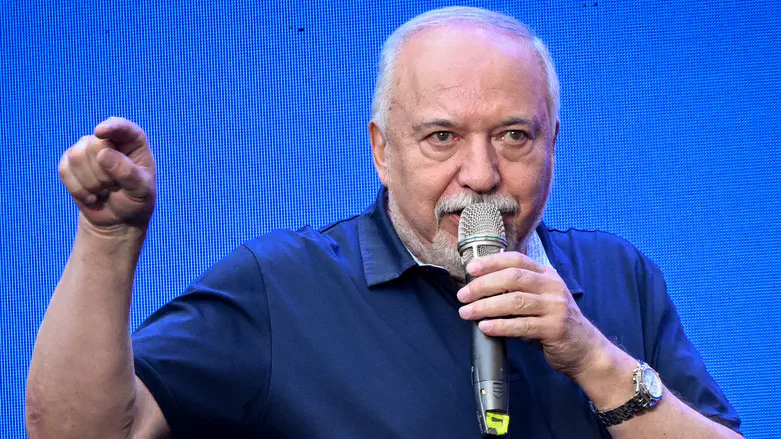
A significant development in negotiations to form Israel's next government: Yisrael Beytenu chairman Avigdor Liberman has lifted his longstanding political boycott of the haredi parties and given his partners in the Change Bloc the green light to negotiate with them, Channel 12 News reported Thursday evening.
The move comes after Liberman repeatedly made clear for years that he would not serve in a government alongside the haredi parties, a commitment he reiterated on the eve of the latest elections.
Before the elections, Liberman established three red lines: refusing to serve in a government with Benjamin Netanyahu, refusing to serve with the haredi parties, and refusing to form a government with the Arab parties.
Now, in light of the election results, he is seeking to prioritize replacing Netanyahu while maintaining his opposition to establishing a government dependent on the Arab parties.
According to the report, the opposition bloc is examining the possibility of establishing a 61-member coalition consisting of the opposition bloc's 48 Knesset members and the 13 MKs from United Torah Judaism and Shas.
One of the central issues standing in the way of an agreement is the military conscription law.
According to the report, negotiations are expected to be based on legislation Liberman advanced in 2018, when he served as Defense Minister in Netanyahu's government alongside the haredi parties.
At the time, the haredi parties opposed the proposal. However, some within those parties now believe it would have been preferable to accept it, given the more stringent proposals introduced since then.
The 2018 framework is considered more lenient than the legislation advanced by MK Boaz Bismuth during the outgoing government's term.
It stipulates that financial sanctions against yeshivas would be imposed only after three years and does not include personal sanctions against yeshiva students who fail to enlist.
The opposition bloc attaches significance to United Torah Judaism's decision Thursday morning not to recommend Netanyahu to President Isaac Herzog as its candidate to form the next government.
Figures within the bloc view the decision as a gesture of seriousness ahead of negotiations, preliminary contacts for which are already underway.
However, the main obstacle remains Shas.
To secure a majority of 61 Knesset members, the bloc would also need the support of Shas, which has announced that it will recommend Netanyahu to form the government.
Shas chairman Aryeh Deri, who returned to the party's leadership following a day of upheaval, is continuing for now to stand by his partnership with Likud.
Rabbi Moshe Maya, the senior member of the Council of Torah Sages, also expressed opposition Thursday morning to joining a left-wing government and called for efforts to establish a unity government.
Meanwhile, the opposition bloc continues to examine another option: establishing a minority government headed by Gadi Eisenkot as early as next week, relying on external support from the Arab parties.
Liberman opposes that possibility, arguing that a government dependent on the Arab parties would not be able to survive for long.