
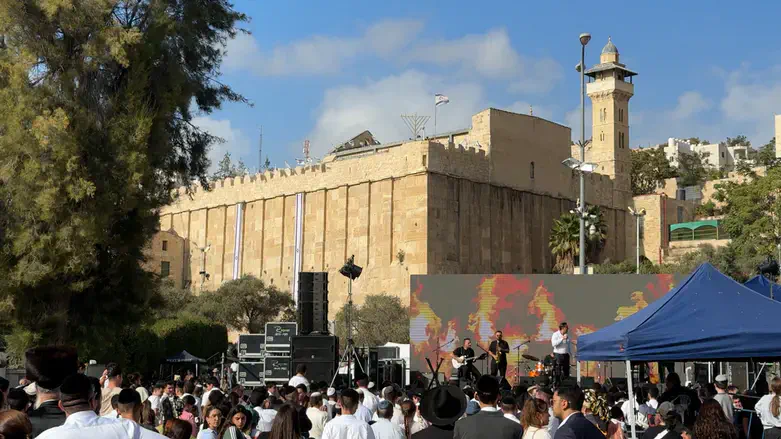
Parshat Chayei Sarah begins with the death of Sarah, and the purchase of the Mearat HaMachepelah in Chevron. According to the Midrashim, Avraham, 38 [approx.] years earlier, had already been exposed to the secrets of the Mearat HaMachpelah, when, during his preparations for the three Angels visiting him, one of his cattle got loose and fled to a cave. Avraham, following the calf, discovered the cave, and realized it was the burial place of Adam and Chavah; from that moment on he desired that location for the burial of his wife and descendants.
Interestingly, while Am Yisrael understands the legacy of our Avot [patriarchs] and Imahot [matriarchs], it is not so well known that the very name “ישראל\Yisrael" has its roots in the name “שרה\Sarah" [See Rokeach in the beginning of Parshat Chayei Sarah]. Sarah was a royal woman, and understood, in some instances even more than Avraham, what needed to be done in order to preserve the honed Mesorah\tradtitions of the house of Avraham; we are therefore titled in her name.
Chida, in Chomas Anach, notes that the first letters of the words “וַתָּ֣מׇת שָׂרָ֗ה בְּקִרְיַ֥ת אַרְבַּ֛ע הִ֥וא" [Bereishit 23’ 2’], which translate to “Sarah died in Kiriath-arba", actually spell out the Hebrew word “אשובה"--I will return. This alludes to, writes the Chida, the fact that the mission and purpose of the world, which had dismally been a failure since the times of Adam and Chava, had now been rectified through the lives of Avraham and Sarah. Seforno writes, however, that while the loss of Sarah was poignantly felt, her passing only took place after the Torah notifies us of the birth of Rivkah, the future wife of Avraham and Sarah’s son Yitzchak. For while the sun has set on our great ancestress Sarah, the sun rises for our matriarch Rivkah [Kohelet 1’ 5’].
With this perspective in mind, we can ascertain greater depths behind the gifts that Eliezer would give Rivkah, in honor of her future marriage to Yitzchak. The Possuk states [Bereishit 24’ 22], after Rivkah had elected to go and bring water for Eliezer and his camels:
“...When the camels had finished drinking, the man took a gold nose ring, weighing half a shekel, and two bracelets for her arms, weighing ten gold shekel…"
Rashi [ad. Loc.] explains that the two bracelets were symbolic of the Luchot [tablets], and the weight of the bracelets (ten gold shekel) was representative of the ten commandments. Astonishingly, notes Rabbi Glatstein, this is the 613th Possuk in the Torah! Thus, at the moment when the next matriarch is joining the mission of creating and crafting Am Yisrael, occurring virtually simultaneously with the death of Sarah, Rivkah is given symbols of Torah and Mitzvot that portend her role as the next matriarch-and much like Sarah, who guided Avraham away from granting legitimacy to Yishamel, Rivkah will use her divine sense to ensure that the legacy of Am Yisrael will transfer through Yaakov, and not Esav. Ergo, we conclude that it is the Chochmas Nashim, the supernatural wisdom of the matriarchs, that actually ensures the proper development of Am Yisrael!