

The United States carried out a strike against Iran's Qeshm Island on Monday as part of a series of limited military operations that Washington has conducted without public acknowledgment in recent weeks, The Wall Street Journal reported, citing American officials.
According to the report, US forces have continued conducting smaller-scale attacks against Iranian targets even as President Donald Trump has publicly expressed optimism about reaching a diplomatic agreement with Tehran.
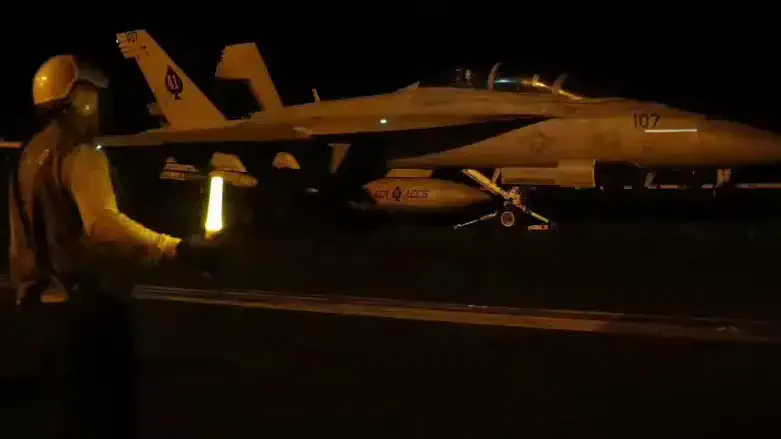
A senior US official commented to Axios on the American strike in Iran, saying that a US military fighter jet struck and destroyed a surface-to-air missile launcher on Iran's Qeshm Island.
According to the official, the strike was carried out in self-defense after Iran's Islamic Revolutionary Guard Corps (IRGC) fired an anti-aircraft missile from the launcher.
The disclosure followed reports on social media of explosions near Qeshm Island on Monday.
American officials described some of the operations as defensive measures intended to restrict Iran's ability to threaten commercial shipping in the Strait of Hormuz.
Unlike during earlier stages of the war, the Pentagon has not publicly announced the strikes.
One official told The Wall Street Journal that Washington had deliberately kept the operations quiet to avoid creating the impression that the United States was preparing to resume a large-scale military campaign against Iran.
The Defense Department referred questions about the reported strikes to US Central Command (CENTCOM), which did not immediately respond to a request for comment.
A US official said the administration was continuing to address threats against American military personnel stationed in the region.
The report emerged hours after Trump downplayed the likelihood of renewed large-scale hostilities following Tuesday's midterm elections.
“We had a war with Iran. We won," Trump told reporters Monday. “I don’t know if you even call it a war because we haven’t been doing any fighting for months."
The President subsequently suggested that an agreement could be reached to reopen the Strait of Hormuz and end Iran's nuclear program, citing falling oil prices as evidence of expectations for a diplomatic breakthrough.
"Oil Prices are DROPPING LIKE A ROCK, down almost $10 a Barrel, A RECORD, because people feel that there will not be a War with Iran. Iran wants a settlement, as soon as possible. It could happen!" Trump wrote on Truth Social.
Vice President JD Vance also expressed optimism Monday about the prospects for negotiations, while emphasizing that any agreement would have to prevent Tehran from rebuilding its nuclear capabilities.
Speaking at Joint Base Andrews, Vance said he had recently discussed the diplomatic efforts with Trump.
"We've had a number of good conversations with the Iranians," Vance said. "I actually spoke with the President of the United States about this an hour ago."
"The President and I both feel pretty good about the prospects for potentially coming to a negotiated settlement. We're going to keep on working at it. You never know, of course. The Iranians are always a little unpredictable, and as the President always says, he retains kinetic options, he retains non-kinetic options," he added.
"We've certainly made some progress. We'll see if we can make some more," Vance said.
Asked whether the administration had set a deadline for Iran to reach an agreement before additional military action, the Vice President said no ultimatum had been issued.
"No, we haven't set deadlines. I mean, look, we've said, 'Here's what we want.' And what we want is, having destroyed their nuclear program, we want to make sure they don't rebuild it or try to rebuild it. That's what matters most to the United States."