

The Central Elections Committee announced early Thursday morning that counting of the double-envelope ballots began at 1:00 a.m., following the completion of the required intake, scanning, and verification procedures.
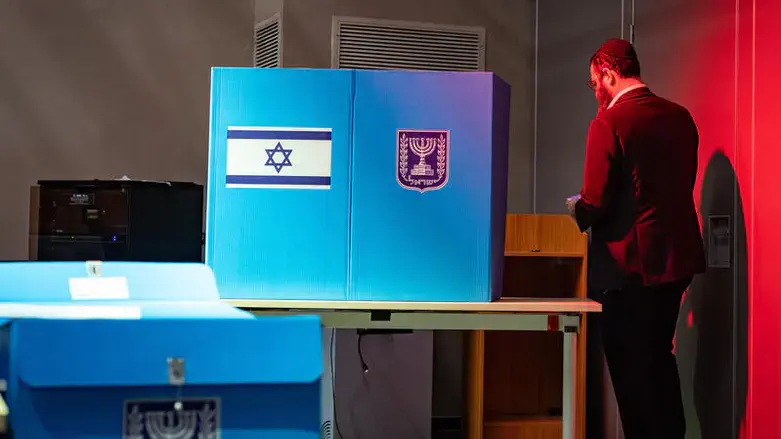
Double-envelope ballots are used in Israeli elections by voters who are unable to cast their ballots at their designated polling stations, including IDF soldiers, hospital patients, prisoners, diplomats stationed abroad, and voters with mobility disabilities who use specially accessible polling stations.
Under the procedure, voters place their ballots in a regular envelope, which is then inserted into a second envelope bearing their identifying information. The Central Elections Committee verifies that each voter has not already voted elsewhere. Once verification is complete, the inner envelopes are removed from the outer envelopes and mixed together to ensure that voters' identities cannot be linked to their votes. The ballots are then transferred to the counting facility in the Knesset parking lot.
According to the interim results from the count of double-envelope ballots so far, the Likud is leading with 18% of the votes, followed by the Beyachad party with 15%, Yashar with 14%, and Religious Zionism with 13.5%.
Shas and United Torah Judaism have each received 3% of the votes counted so far, while the Joint List stands at just 1%.
Likud leads with 26 seats, followed by Yashar with 21. Together has 12 seats, the Joint List with 11, the Democrats and Ra’am at eight, while Yisrael Beytenu, United Torah Judaism, Otzma Yehudit, and Shas each stood at seven. The joint Religious Zionist Party-Zehut list stood at six seats.
The Reservists-Economic Party remained below the electoral threshold with 2.63% of the vote, as did Amcha Yisrael with 1.6%.