


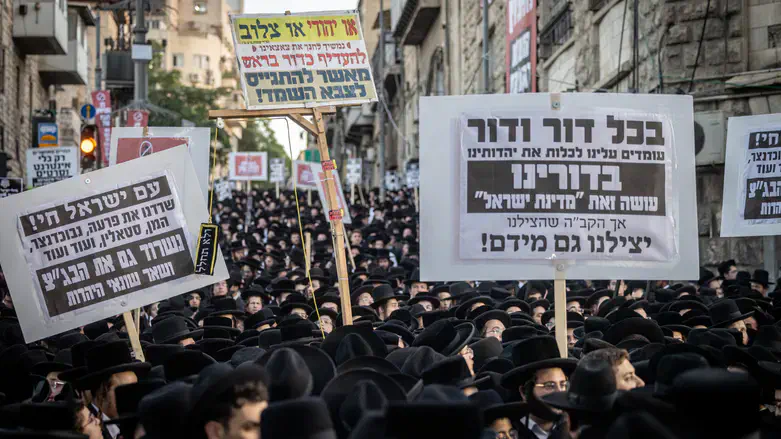
As the election campaign enters its final stretch, Prime Minister Benjamin Netanyahu is stepping up his efforts and placing the issue of haredi military enlistment at the center of his campaign.
In an interview Sunday morning with Benny Teitelbaum on Kan Moreshet, Netanyahu addressed the sensitive issue at length, presented the government's proposed enlistment framework, and delivered an unequivocal message to haredi groups that oppose any service in the IDF.
"We introduced a law, and I will pass it, to enlist 23,000 haredim over three and a half years. They proposed 5,000; that was their proposal," Netanyahu said, in an apparent criticism of his political rivals.
Asked why his government had failed to pass the legislation during its four years in office, Netanyahu explained: "We almost succeeded. In the end, we were really just one Knesset seat short. I assume that if we receive more seats, we will be able to pass it this time, and that will truly be an important correction."
Regarding the central principles of the proposed enlistment law, Netanyahu emphasized that there must be a clear distinction between those who devote all their time to Torah study and those who do not actually study.
"Someone who is not going to enlist, or someone who says, 'I have respect for the world of Torah study'-but anyone who does not study must enlist."
Netanyahu then used particularly harsh language in addressing extremists and those who categorically incite opposition to military enlistment.
"And anyone who says, 'We will die rather than enlist,' let him go to prison."
Alongside the enlistment issue, Netanyahu used the interview to issue strong warnings against splitting the right-wing vote. He sharply criticized competing parties, particularly those seeking to draw votes away from Likud.
He described these groups as the "fake right" and warned that voting for small parties that could fail to cross the electoral threshold would directly lead to the formation of a left-wing government supported by Arab parties.