
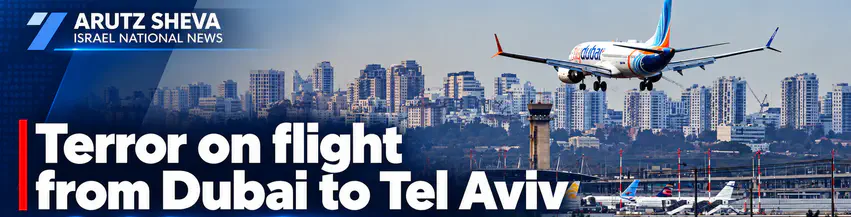


Former National Security Adviser Meir Ben-Shabbat, currently head of the Misgav Institute for National Security, spoke with Arutz Sheva - Israel National News about the investigation into the attempted terrorist attack aboard a Flydubai flight to Israel.
During the interview, Ben-Shabbat warned Arutz Sheva that the incident presents significant challenges for aviation security worldwide.
"My impression is that the investigation so far is being conducted cooperatively," he said. "The United Arab Emirates also has an interest in fully investigating the incident, understanding who was behind the attempt and how it happened. Otherwise, it will be difficult for them as well to close the security gaps that made it possible."
Drawing comparisons to the September 11 attacks, Ben-Shabbat warned that the threat to aviation security could come from within the aircraft's own crew, rather than from passengers.
"It is much harder to deal with an enemy from within, someone who is already part of the system: a pilot, a maintenance technician, or any other employee who has legitimate access to an aircraft," he explained.
Recalling the 2015 bombing of a Russian Metrojet aircraft over Egypt's Sinai Peninsula, which killed all 224 people on board, he noted that Investigators suspected that the explosive device had been planted with the assistance of someone working at the airport.
Ben-Shabbat also emphasized that identifying potential attackers has become increasingly complicated, particularly when dealing with individuals who undergo radicalization independently.
To address the threat, he recommended greater intelligence sharing between countries, improved screening and reliability checks for aviation personnel, increased intelligence efforts, and stronger oversight mechanisms.
"None of this guarantees a foolproof solution, but these measures can reduce the risks," he said, stressing that the recommendations must be implemented immediately to prevent possible copycat attacks.
Regarding the Iranian threat, Ben-Shabbat warned that Tehran could seek to exploit the upcoming election periods in Israel and the United States.
"The difficult situation Iran finds itself in could certainly push it to exploit what it perceives as opportunities, whether by acting directly or by encouraging its proxies to act," he explained.
Asked whether Israel should exercise restraint in its operations against Hezbollah and Hamas during the election campaign, Ben-Shabbat insisted, "Security operations must continue during the election period without being affected in any way. The State of Israel does not have the luxury of stopping or even slowing down until the elections are completed and a government is formed, and who knows how long that will take?"
Ben-Shabbat also addressed growing concerns over potential kidnapping attacks by Hamas or other Gaza-based terrorist organizations, explaining that the terrorist group is increasingly desperate as Israeli military pressure continues.
"Hamas is in distress. Israel's counterterrorism apparatus is operating relentlessly. Every day, the sword hangs over the heads of its senior officials and operatives. Under these conditions, the organization is struggling to stabilize itself," he said.
According to Ben-Shabbat, Hamas has been unable to generate sufficient international pressure to restrain Israeli operations and is therefore turning to a tactic it believes has proven effective in the past.
"Under these circumstances, Hamas is returning to an option that, from its perspective, has proven successful: kidnapping attacks."
He urged Israel to prevent such attacks through both heightened security measures and continued offensive operations throughout Gaza.
"The counterterrorism apparatus must operate relentlessly, everywhere in the Gaza Strip, at every level, and at all times," he urged. "Only in this way can Hamas operatives be forced to flee from place to place, remain in hiding, and devote all their energy to survival."