
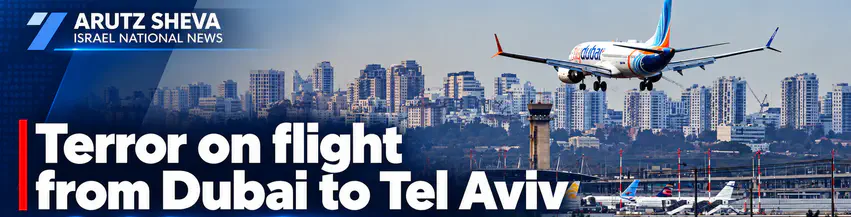
Israel’s spirit of bravery was once again revealed today in the remarkable rescue of a flight from Dubai.
The incident recalled the courage displayed during the October 7th massacre, when security systems collapsed, and ordinary people were forced to rise to the occasion. On a smaller scale, something similar occurred aboard the Dubai flight: a jihadist pilot attacked the aircraft’s main pilot, sending the plane into a rapid descent of approximately 20,000 feet in just one minute.
As the aircraft’s systems were thrown into chaos, Israeli passengers sprang into action. They broke into the cockpit, restrained the jihadist pilot, and other pilots took control of the aircraft, ultimately saving everyone on board. It was a remarkable rescue.
The passengers responded by singing songs of prayer and thanksgiving.
From this event, it is fitting to return to the concept of "the Torah of the Land of Israel," particularly in light of Maimonides’ explanation of the beginning of the levels of prophecy in The Guide for the Perplexed, Part Two, Chapter 45.
Maimonides writes that the beginning of prophecy is when divine assistance accompanies a person, awakening and encouraging him to undertake a great and valuable act, such as rescuing a group of righteous people from the wicked, saving a great righteous individual, or positively influencing many people.
A person who experiences this awakening, Maimonides explains, is said to have been touched by "the spirit of the Lord," with expressions such as "the spirit of the Lord has come upon him," "the spirit of the Lord has clothed him," or "the Lord was with him."
According to Maimonides, this is the level associated with the judges of Israel, of whom Scripture states: "For when the Lord raised up judges for them, the Lord was with the judge and saved them." It is also the level associated with Israel’s righteous kings, including King David.
The Bible describes this spirit in the stories of several judges and kings. Regarding Jephthah, it says, "Then the spirit of the Lord came upon Jephthah." Regarding Samson, "the spirit of the Lord rushed upon him." And regarding Saul, "the spirit of God rushed upon Saul when he heard these words."
The same spirit is described in the case of Amasa, when he was moved to join David: "And the spirit clothed Amasa, head of the officers of the third division: Go, David, and be with your son of Jesse in peace."
Maimonides further explains that this power remained with Moses from the time he reached adulthood. It moved him to act when he saw injustice, first when he killed the Egyptian who was striking a Hebrew and later when he intervened between two disputing Hebrews. Even after Moses fled Egypt and arrived in Midian as a stranger and refugee, he could not stand by when he witnessed injustice. "And Moses arose and saved them," the Torah says, describing how he defended the daughters of Jethro at the well.
This is the spirit of Israel’s bravery: the spirit of the Lord that moves a person, at a decisive moment, to rise and perform an act of rescue.
According to Maimonides, this awakening represents the first level on the path to prophecy. It is the inner call to responsibility, to refuse to stand aside when action is needed and to rise to the occasion.
Those who have studied the Torah of the exile, from Babylonia to Lithuania, are called to rise and rediscover "the Torah of the Land of Israel." Here, that spirit of responsibility, courage, and rescue is revealed: the call to recognize the moment, refuse passivity, and act.