

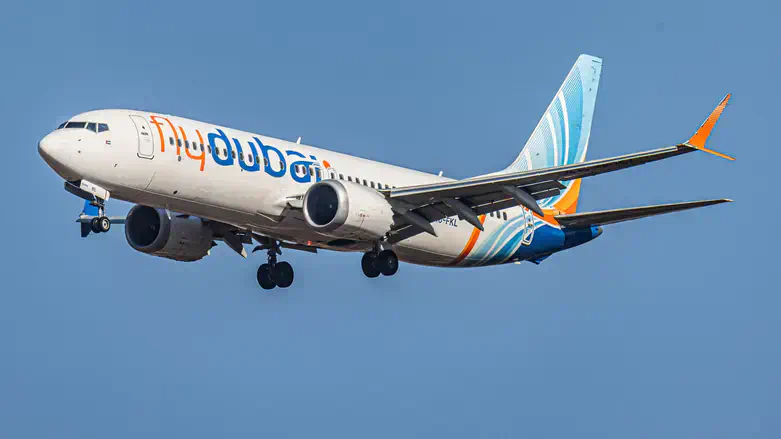
Hours after the dramatic incident aboard a Flydubai flight bound for Israel, Israeli officials still do not know with certainty what motivated the alleged attack, but indications that it was carried out for nationalist motives are growing.
Jerusalem is awaiting the results of the interrogation in Saudi Arabia of the Omani co-pilot suspected of stabbing the pilot and attempting to crash the aircraft.
Mossad Director Roman Gofman is overseeing Israel's handling of the incident, including contacts with Saudi authorities and the investigative aspects of the case.
Israeli authorities are also examining how an Omani national was authorized to serve as a pilot on a flight to Israel. Due to the geopolitical sensitivities surrounding Middle Eastern countries, foreign crew members, particularly those from Arab and Gulf states, undergo individual security screening before receiving authorization to enter Israeli airspace and land in the country.
One possibility under investigation is that the co-pilot holds dual citizenship that allowed him to operate the Israel-bound flight. Israeli officials understand that he has worked for Flydubai for less than a year.
Meanwhile, a replacement Flydubai aircraft sent to retrieve the passengers has landed in Saudi Arabia. Saudi authorities have so far not permitted Israel to independently evacuate the Israeli passengers.
Passengers began boarding the replacement flight to Israel, which is expected to land at 6:00 p.m., though some have refused to board. Israeli security officials are expected to question the passengers upon their return.
Following the incident, Transportation Minister Miri Regev demanded the suspension of Flydubai flights to Israel until the investigation is completed and called for Israeli airlines' routes to Dubai to be restored. The demand sparked a sharp disagreement between Regev and Shin Bet Director David Zini.
Regev also instructed the Civil Aviation Authority to examine whether Flydubai violated aviation agreements with Israel, under which pilots landing in Israel must hold passports from countries that maintain diplomatic relations with the Jewish state.
The drama began at approximately 9:00 a.m. Wednesday, when Israeli authorities received a hijacking signal from the aircraft.
Israeli Air Force fighter jets were immediately scrambled, while senior political and security officials held emergency consultations in Jerusalem.
At approximately 9:30 a.m., the aircraft disappeared from tracking systems for several minutes, intensifying fears of a hijacking. It subsequently reappeared on civilian flight-tracking systems and landed at an airport in Saudi Arabia at approximately 10:00 a.m.
Following the landing, Israeli airspace was reopened to air traffic.
Flydubai initially confirmed that an altercation between members of the cockpit crew had occurred, but Israeli officials increasingly suspect that the incident was considerably more serious.
According to Israeli officials, indications are mounting that the co-pilot intended to crash the aircraft with its passengers aboard.
Data published by flight-tracking service Flightradar24 showed the aircraft rapidly losing altitude while simultaneously accelerating.
"One pilot stabbed the other and tried to carry out a 9/11 - either to hijack the plane to Israel or crash it," a senior Israeli official told Channel 12 News.
"The plane began to dive, and a team of pilots who were there took control of the attacker and the aircraft. A dramatic disaster was averted."
Passengers and crew members who realized what was happening reportedly managed to break into the cockpit and overpower the suspected attacker.
Israeli officials were informed that an additional flight crew happened to be aboard the aircraft as part of a routine procedure. The pilots were traveling as passengers and were able to take control of the aircraft and stabilize it.
"The great fortune of this flight was those pilots," a senior Israeli official said. "Otherwise, we would have been dealing with an incident straight out of September 2001 or July 1976."
In the wake of the incident, Prime Minister Benjamin Netanyahu, who had been traveling to southern Israel, turned back to participate in another security consultation in central Israel.