

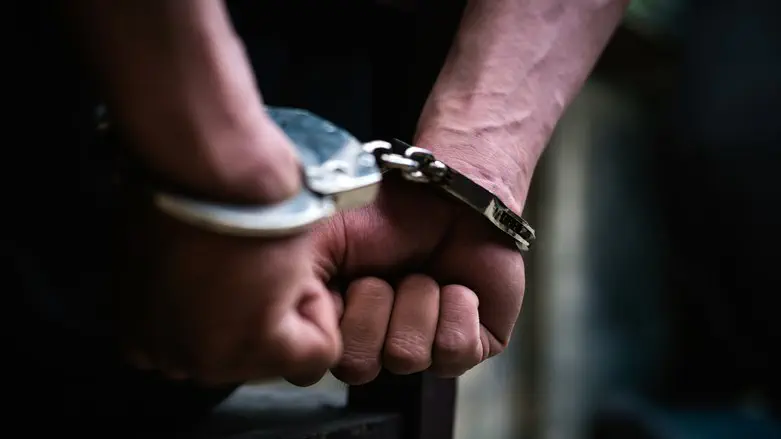
Three Palestinian Arabs convicted of throwing Molotov cocktails at a building on the Oz Zion hilltop community in Binyamin while four hilltop activists were sleeping inside were sentenced to 70 months in prison. The Honenu organization criticized the sentence and is demanding that the military prosecution appeal it.
The incident occurred on the night between April 22 and 23, 2021. According to the indictment, Majd Halmi Musa Barakat, Mahmoud Sultan Khalil al-Nabbut, and Jihad Ahmad Afon Baraka, residents of the village of Burqa, approached the hilltop, and each of them threw a Molotov cocktail at a caravan that they claimed stood on land belonging to members of their families.
At least one of the Molotov cocktails entered the building and ignited. The four hilltop activists who were sleeping there woke up after the fire had already begun burning and managed to escape.
A panel of the Judea Military Court, consisting of Lt. Col. Bella Gelfand, Maj. Roi Mellinger, and Maj. Meir Arbel, sentenced the three to 70 months in prison from the date of their arrest, 16 months' suspended imprisonment, and compensation of 5,000 shekels to the victims of the crime.
One of the issues addressed in the sentencing decision was the motive for the acts. The court did not accept the position that it had been proven that the incident had an unequivocally nationalist motive.
“However, I was not convinced that in our case it was established that the nature of the background to the acts was unequivocally nationalist, as is often the case. The indictment explicitly sets out the background that led to the incident - trespassing - and the defendants’ objective in their actions - revenge and causing damage to the caravan because of that trespassing," the ruling stated.
The court further ruled: “It can be determined that the decision to take action against settlers was, naturally, formulated with the clear knowledge that they were settlers. On the other hand, it was not a decision formulated because of their national or religious affiliation or against an ideological background."
Honenu argues that the sentence imposed on the three was too lenient. Attorney Haim Bleicher of the organization’s Terror Victims Department contacted the Military Advocate General’s Office on behalf of the victims and requested an appeal of the sentence and a demand for harsher punishment.
“The court’s treatment of the brutal attack as an ordinary dispute, rather than as part of the overall campaign against the Jewish people in their land, constitutes a severe blow to all Israeli citizens, to deterrence, and to the spirit of the people dwelling in Zion," the appeal request stated.
Bleicher added: “The court’s ruling ignores the true context of the attack - a serious attack in which they attempted to burn an entire Jewish family, babies in their beds. It is only by a miracle that this was not one of the most serious terrorist incidents in Judea and Samaria."
“The court erred in giving the terrorists an extremely lenient sentence," he continued. “The fact that there is a dispute over the land does not diminish in the slightest the brutality of the attack or the war in which we find ourselves. We will work to ensure that an appeal is filed, and we hope that the Military Court of Appeals in Judea and Samaria will come to its senses and impose severe punishment on the terrorists."