
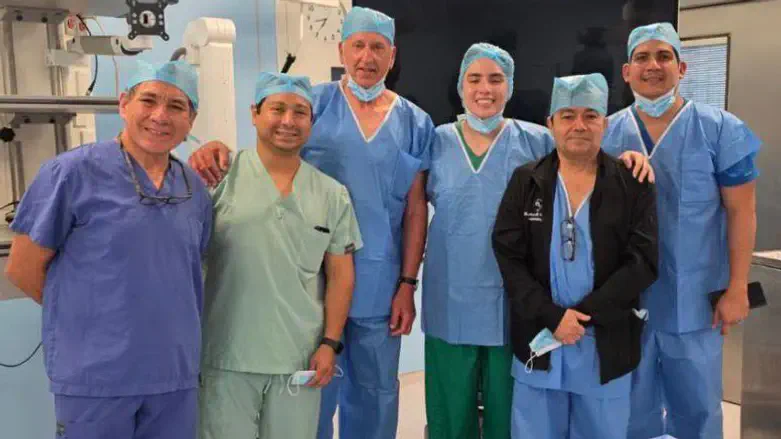
Prof. Ron Eliashar of Hadassah Medical Center participated in Ecuador in a complex operation to remove a tumor that had spread from the nasal cavity and sinuses through the base of the skull and into the brain.
Eliashar, director of the Division of Head, Face and Neck Surgery and Reconstructive Surgery and director of the Department of Otolaryngology-Head and Neck Surgery at Hadassah, was called in to assist the local team while he was in South America for a professional conference.
The case began when a patient in the city of Guayaquil was diagnosed with a large brain abscess. She underwent emergency surgery at another hospital, where the pus was drained. During the operation, suspicious tissue was discovered, and a biopsy revealed an inverted papilloma - a benign but aggressive tumor originating in the nasal cavity and sinuses that had broken through the skull base and into the brain.
The person who contacted Eliashar was Dr. Andres Sancho, a local ENT physician who had previously trained in Eliashar’s department at Hadassah and then completed two additional years of training in rhinology and endoscopic surgery. His wife, Dr. Leah Morjon, trained in neurosurgery at Hadassah, and the two subsequently returned to Ecuador as specialists in their respective fields.
“I traveled to Ecuador on behalf of the Israel Medical Association to participate in a conference of Latin American medical professional associations," Prof. Eliashar recounted. He said that just before his trip, Dr. Sancho called and asked for his assistance with the complex medical case.
Following the initial treatment, the patient’s condition soon deteriorated again, and the team concluded that a combined operation involving both a neurosurgical team and a rhinology team was required. The surgery was planned to be performed simultaneously using an endoscopic approach through the nasal cavity and sinuses and an open neurosurgical approach through the skull.
“The team on the other end of the phone explained that they did not have the necessary expertise for the endoscopic portion of such a complex operation," Eliashar said. “After they sent me the CT and MRI results so that I could assess the severity of the case, I really didn’t think twice. I agreed with them that the only way to save the patient was to perform a combined operation as soon as possible."
Eliashar joined the local team, which included Dr. Sancho, Dr. Morjon, and senior neurosurgeon Dr. Alberto Valarezo, who had also previously trained at Hadassah. It thus emerged that all four surgeons who participated in the operation - two ENT surgeons and two neurosurgeons - had undergone training at Hadassah.
“The operation, which we performed using a hybrid approach, required advance preparation and meticulous planning of every stage, including sealing the skull base and separating the brain from the nasal cavity and sinuses after the tumor was removed," Eliashar explained.
“The teamwork was excellent, the operation proceeded as planned, and in the end we achieved the desired result. After the tumor was removed and she recovered from the surgery, the patient’s condition improved dramatically, and she is feeling excellent."
Eliashar also addressed the importance he places on training foreign doctors in Israel.
“The local doctors, all of whom trained at Hadassah, brought excellent medicine back with them when they returned to their country and serve as good ambassadors for the State of Israel," he said.
According to Eliashar, foreign doctors receive their training in addition to Israeli physicians and not at their expense, and after completing their training they are required to return to their home countries.
Eliashar added that sharing knowledge and experience with doctors from other countries, and through them with healthcare systems around the world, is part of Hadassah’s vision as an international medical center.