

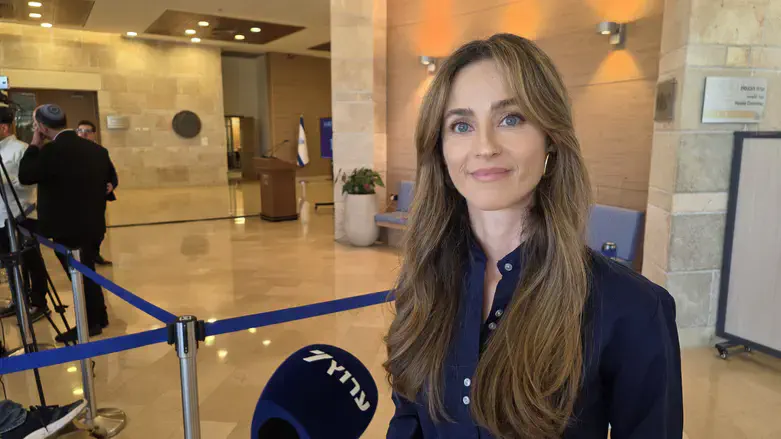
MK Meirav Cohen on Monday submitted the "Together" slate, headed by Naftali Bennett, to the Central Elections Committee for the Knesset. In an interview with Arutz Sheva-Israel National News following the submission, Cohen described the moment as significant in what she called a "historic" election.
"We are in a historic election, and today, in a very moving moment, we submitted the 'Together' slate headed by Naftali Bennett to the Central Elections Committee," Cohen said. "We stand behind the leadership of Naftali Bennett, who was the Prime Minister of change. We worked together back then, and we know it works well."
According to Cohen, Bennett's experience in various government positions has given him the tools needed to tackle the challenges facing Israel. "We know that he knows how to run a country, and we know that he knows how to make sound decisions for the benefit of all the people of Israel. I think Bennett's experience in a number of government ministries - education, the economy, the Defense Ministry and as prime minister - will enable him to manage the highly complex issues that must be addressed now for the sake of the people of Israel."
Cohen identified haredi enlistment as one of the key issues she said the next government will have to address. "I believe he will go all the way in solving the acute problems that we have truly been putting off addressing since the establishment of the state. First and foremost, this means enlistment for everyone, ending draft evasion, and also dismantling the political control over haredi schools."
Asked about the political price paid by politicians who have dealt with the issue of haredi enlistment, Cohen called for taking the issue out of the partisan debate.
"This is a discussion that rises above politics, because without it there is no longer a State of Israel. That's it, it's over," she said. "This is no longer a theoretical discussion about equality and values. This is already a practical question: Who will defend the borders? We have a war on many fronts, no front has been closed, and we have lost so many heroes. We have 26,000 wounded, and we need manpower."
According to Cohen, the question of who gained or lost politically from addressing the issue has become secondary. "It's no longer about who gained and who lost. This is above all that. There is no State of Israel if this continues."
Cohen was also asked whether the large number of candidates in the bloc opposing Prime Minister Benjamin Netanyahu, including Bennett, Gadi Eisenkot and Avigdor Liberman, could give Netanyahu an advantage in the election.
"There is no doubt that our bloc is much more heterogeneous, and it's also no secret that I very much supported uniting and rallying behind a single candidate," she replied. However, she said that even without a full merger, the parties could coordinate their efforts: "We can work in coordination, make sure that no party falls below the electoral threshold, strengthen the bloc and increase voter turnout."
Regarding the question of who should be the candidate for Prime Minister, she added: "The day after [the election], we will enter a room and, according to the results, choose an agreed-upon candidate. We will not allow any consideration that is not substantive to stand in the way, because the State of Israel is in danger."
Toward the end of the interview, Cohen addressed changes to the slate and Knesset members and political figures who were not placed in realistic positions.
"Yesterday we launched the slate at a festive event, and I can tell you personally that it was difficult for me," she said. "Some of my very good friends were not with me on the stage, and they are good people who did amazing work here in the Knesset and worked very hard during very, very difficult years. They did work that wasn't glamorous and wasn't fun, and it really breaks my heart that they weren't there."
Cohen noted that some of her colleagues had decided on their own to step aside after years in politics, while others understood that there would be no realistic place for them on the slate under the current political circumstances.
"Either way, everyone decided to remain within the party and do it respectfully, and some of them are even still holding home gatherings," she said. "I think Lapid tried to handle it as sensitively as possible, but that's politics."
Asked whether the changes signaled the decline of the Yesh Atid party, Cohen rejected the possibility. "On the contrary. The moves that were made ensure that the future generation of leadership will remain here even after generations change."
She further stated that Yesh Atid's survival over the years is itself evidence of its resilience. "This is a life's work that has truly managed to survive for 13 years in the very, very turbulent waters of Israeli politics. I haven't seen many parties manage to survive all the political upheavals in the country. As difficult and unpleasant as this move was, it ensures that a new generation of leadership will emerge within the party and secure its continued existence."