
A special team from Israel’s Harel insurancecompany is expected to depart for Nepal in the coming hours to assist in the search for Israelis in their 60s who went missing following severe flooding and landslides in the country.
The delegation includes about eight Israeli rescuers and will also search for a group of foreign tourists who were traveling with the Israelis near Chhuyang Wuwa (Headwa), close to the Nepal-China border crossing. According to information received by the firm, the Israelis were hiking with the group when powerful floods and mudslides severed contact and the group’s trail was lost.
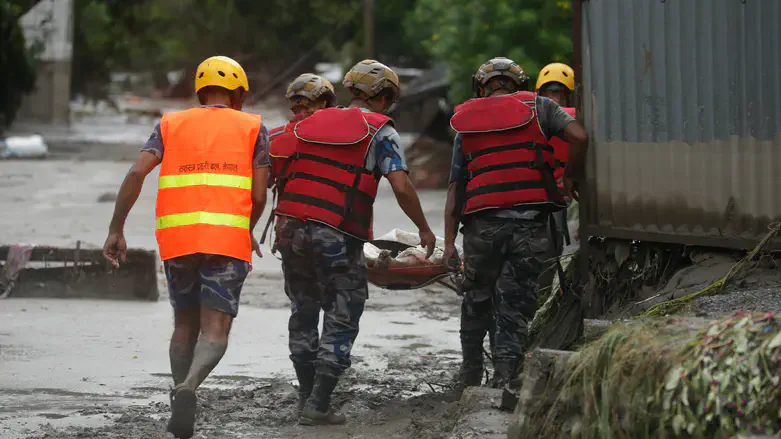
The search is expected to be carried out under extremely difficult conditions. Heavy and unusual weather has caused widespread destruction, blocked roads and isolated entire areas. The Israeli rescuers are preparing to operate in a remote, mountainous region where some areas cannot currently be reached by road.
The team described the mission as a “complex rescue operation" because of the terrain and extensive infrastructure damage. Teams are expected to conduct searches on foot while using drones, surveillance systems and other technological capabilities. “Some of the roads in the area were blocked, access to parts of the terrain is limited, and the terrain conditions present significant operational challenges for the search and rescue teams," the unit said. It added that its personnel remain in continuous contact with the Israelis’ family, the Foreign Ministry and other agencies operating in the area.
The Israeli delegation is heading to Nepal as the full scale of the disaster continues to emerge. At least 353 people have reportedly been killed, while more than 1,300 remain missing, including hundreds of tourists and foreign nationals from dozens of countries.
The disaster began after a massive collapse of ice and rocks in the Himalayan region. Initial findings and satellite imagery indicate that part of a glacier broke away at high altitude and plunged into a valley, generating a powerful torrent of water, mud and rocks that rapidly swept through populated areas.
Early reports suggested that an earthquake may have triggered the disaster. However, the U.S. Geological Survey said the seismic activity recorded in the area was likely generated by the collapse itself. Investigators are continuing to examine the precise chain of events.
The floodwaters traveled along rivers in Nepal, destroying homes, vehicles and infrastructure. Roads and bridges were washed away, hydroelectric facilities were damaged, and entire communities were left without electricity or communications. In some locations, water levels reportedly rose by several meters within a short period.
The fate of hundreds of tourists and hikers who were in the region when the disaster struck remains a major concern. Authorities report that 826 people are missing in Nepal and another 558 in Tibet, including foreign nationals from multiple countries.
The destruction of roads and other infrastructure has severely complicated rescue efforts. Nepalese forces are using helicopters alongside ground teams, with more than 100 people already rescued by military helicopters. Authorities are also monitoring the risk of further flooding. In Tibet, concerns have been raised over a lake that may have formed, been blocked or breached following the landslide, potentially triggering another surge of water downstream. The disaster has also disrupted tourism and pilgrimage routes across the Himalayas. Some of those missing were reportedly traveling toward Mount Kailash and Lake Manasarovar, sites considered sacred by Hindus and Buddhists.