

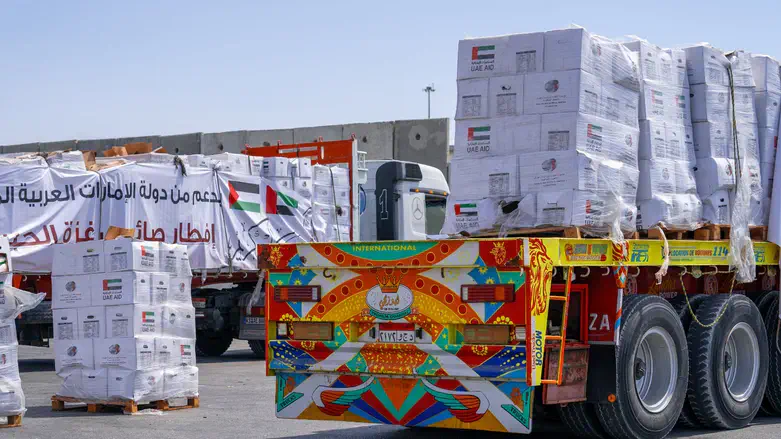
The IDF on Wednesday published data detailing the scope of humanitarian assistance entering the Gaza Strip since the ceasefire took effect in October 2025, reporting significant increases in food supplies, water infrastructure and medical capacity.
According to the IDF, more than two million tons of food have entered Gaza since the beginning of the ceasefire, including meat, poultry, eggs, cheese, fruits and vegetables.
The military said that food prices in the Gaza Strip have fallen by approximately 72% during that period.
Approximately 600 trucks currently enter Gaza every day, according to the IDF, with between 70% and 80% carrying food.
In addition, 41 bakeries operated by international organizations are currently functioning throughout the Gaza Strip and producing more than three million pita breads each day, alongside dozens of local bakeries.
The IDF also presented figures regarding Gaza's water supply, saying that more than 70,000 cubic meters of water are supplied to the Strip on an average day, amounting to more than 60 liters per person.
Approximately 250 water trucks operate daily and supply some 2,800 distribution points throughout Gaza.
Since the ceasefire began, more than 78,000 tons of hygiene and sanitation supplies have also entered the Strip, together with equipment for waste removal and water purification tablets.
Four water pipelines are currently operational, three of which carry water into Gaza from Israel. They operate alongside desalination facilities, including two major desalination plants, as well as dozens of water wells throughout the Strip.
One of the major desalination facilities, located in Khan Yunis, is connected to the "Kela" electricity line from Israel.
The IDF reported significant developments in Gaza's medical system as well. More than 21,000 tons of medical equipment have entered the Strip since the ceasefire began, while the number of available hospital beds has increased by more than 50%.
Advanced medical equipment, including X-ray machines, generators and oxygen tanks, has also entered Gaza in coordination with international organizations.
According to the military, eight permanent hospitals, four field hospitals and four medical centers are currently operating in northern Gaza. In the southern Gaza Strip, two permanent hospitals and eight field hospitals are operating.
The IDF said that the overall volume of aid entering the Gaza Strip "significantly exceeds the humanitarian needs" as defined by UN agencies and international organizations, as well as assessments conducted during the war.
At the same time, the military accused Hamas of remaining the principal obstacle to further improvements in humanitarian conditions.
According to the IDF, Hamas interferes with humanitarian operations, exploits civilian infrastructure, seeks to influence aid distribution mechanisms and repeatedly attempts to smuggle prohibited items into the Gaza Strip under the guise of humanitarian assistance.
"Israel will continue working together with its international partners to improve the humanitarian response, while preventing Hamas from exploiting it at the expense of Gazan civilians," the IDF stated.