
Dr. Michael Wise is a founder and investor in numerous technology companies. He is a graduate of YU and holds a PhD .in Theoretical Physics from Brandeis U., is the author of Israel demography study (BESA) and has published numerous articles about Israel sovereignty and demographics in Judea and Samaria. mlwise@gmail.com
The Convoy Headed to Hamas
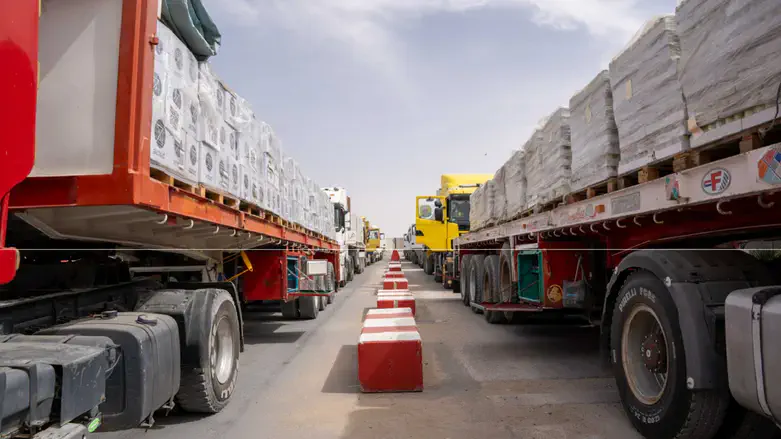
Six hundred trucks loaded with humanitarian supplies, are directed into the Gaza Strip every day, where Hamas - a designated terrorist organization - controls the distribution of goods. That is not a minor logistical detail. When an armed militant group controls what comes in and who gets it, calling the delivery "humanitarian" requires a generous stretch of the word. Ownership of those 600 trucks enables Hamas to extend the imprisonment of the vast majority of Gazans who wish to escape from the Hell that Hamas created.
The trucks are not unloaded by neutral aid workers operating freely. They will move through territory governed by a group that has, by its own record, diverted aid for military purposes, taxed civilian supplies, and used humanitarian infrastructure as cover. That is not speculation. It has been documented by UN agencies, investigative journalists, and even internal reviews from organizations operating inside Gaza.
The question is not whether people in the region are hungry. Some clearly are. The question is whether this particular convoy, structured this way, actually feeds hungry people - or whether it serves a different purpose entirely. Less than 250 km (150 miles) away
The Druze Are Being Ignored
The Druze are a small, ancient religious minority spread across Syria, Lebanon, and Israel. 700,000-800,000 Druze live in Syria, 400,000 in Lebanon, and 160,000 in Israel.
Most Syrian Druze live in Suwayda Province, adjoining the Golan south of Damascus. During the Syrian civil war, jihadist groups (ISIS, al-Nusra) threatened Druze communities near the Golan. They welcomed Israeli medical aid during the Syrian civil war for wounded Syrians (including Druze) in field hospitals.
As a community, they have expressed open support for Israel in spite of the fact that publicly supporting Israel is treated as treason. Syrian Druze actually feel they are brothers to Druze living in Israel. They appreciate Israel’s great respect for Israel’s Druze population. They know that Israeli Druze serve in the IDF, hold public office, and are integrated into Israeli society. Syrian Druze see Israeli Druze as successful, safe, autonomous, respected and strongly identify with Israel.
Syrian Druze demonstrations have used Israeli flags to attract attention from Israel, the U.S., and Western media. The message is: “We need protection from jihadists and regime abuses." In addition, Syria Druze communities now face serious pressure, periodic violence, and genuine food insecurity. They are not a powerful political bloc. They do not have a well-funded lobby in Brussels or New York. They do not generate the kind of international media attention that the Palestinian Arabs do and that moves aid budgets. They are ignored.
600 trucks loaded with genuinely humanitarian aid would be a life-saver for them.
There is no flotilla for the Druze. There is no emergency session at the Human Rights Council. There are no celebrities posting about their plight. If humanitarian concern were truly universal and evenly applied, the Druze would be part of this conversation. They are not, and that absence is worth correcting.
Egyptians Are Starving Too
Egypt is one of the most food-insecure large countries in the world. Inflation has devastated purchasing power. The Egyptian pound has lost enormous value over the past two years. Bread lines are growing. Malnutrition among children, particularly in Upper Egypt and rural areas, is a documented and ongoing crisis.
Egypt shares a border with Gaza. It is geographically impossible to miss. And yet the international humanitarian machinery that can mobilize 600 trucks for Gaza cannot seem to find the bandwidth to address what is happening just across the Sinai.
This is not an argument against helping people in Gaza. It is an argument for honesty about who is actually being helped, and who is being skipped over because they are not politically useful to the narrative.
What the Global Hunger Index Actually Shows
The Global Hunger Index ranks countries based on undernourishment, child wasting, child stunting, and child mortality. It is one of the most cited tools in international food security policy. It is also rarely mentioned in the same breath as the Gaza Strip, because the data does not fit the preferred story.
Countries like Chad, Madagascar, the Central African Republic, Sudan and Yemen consistently rank among the worst in the world for hunger. Millions of children in these countries are stunted or wasted. Mortality rates from hunger-related causes are staggering. The humanitarian response to these crises is chronically underfunded.
Meanwhile, the Gaza Strip receives a volume of international attention and aid mobilization that is, by any objective measure, disproportionate to its ranking on indices like this one. That is a choice being made by governments, institutions, and donors. It should be acknowledged as a choice, not dressed up as neutral humanitarianism.
The Real Purpose of This Aid
Aid directed into Hamas-controlled territory under current conditions functions, at minimum, as political cover. It allows governments and international bodies to say they are doing something while avoiding harder questions about accountability, distribution, and outcomes.
At its worst, it materially benefits an armed group. Hamas has a demonstrated history of controlling civilian resources for strategic purposes. Fuel, food, and medicine that enter Gaza do not simply appear on the shelves of ordinary families. They move through a system that Hamas manages, taxes, and directs.
Calling this aid "humanitarian" without addressing who controls it is not compassion. It is theater.
Where Is the UN? Where Is the EU?
These are fair questions. The United Nations has an enormous infrastructure devoted to global hunger. The World Food Programme, UNICEF, and FAO collectively manage billions of dollars in annual aid. The European Union is the world's largest donor of humanitarian assistance.
And yet, when it comes to applying consistent standards - demanding accountability for aid distribution, ensuring that supplies reach civilians rather than armed factions, and allocating resources based on actual need rather than political salience - both institutions fall short in ways that are hard to explain charitably.
The UN's own internal watchdog, OIOS, has repeatedly flagged problems with aid diversion in conflict zones. UNRWA, specifically, has faced credible allegations and proof that employees participated in or had knowledge of the October 7 attacks. Several donor countries suspended funding as a result. The institution's response was largely defensive.
If the UN and EU want to be taken seriously as neutral humanitarian actors, they need to apply the same scrutiny to Gaza aid that they claim to apply everywhere else. The current approach - volume without accountability - is not working, and more trucks will not fix that.
Conclusion
Humanitarian aid is a serious enterprise with serious consequences. When it is done well, it saves lives. When it is done carelessly - or cynically - it can prolong conflicts, enrich armed groups, and crowd out the people who actually need help most.
Six hundred trucks is not a small operation. It represents real resources, real political capital, and real opportunity costs. Those resources could reach Druze communities under pressure in Syria. They could address food insecurity in Egypt. They could fund programming in Chad or Madagascar, where children are dying of hunger with almost no international attention.
The choices being made here are not inevitable. They are political. And the people making them - in Brussels, in Geneva, in New York - should be asked to justify them clearly, without the shield of humanitarian language that papers over what is actually happening on the ground.
The 600 daily trucks supplied to and supporting the Hamas terrorist regime should immediately be redirected to the Druze bordering the Golan who would be delighted to share the destiny of their Israeli Druze brethren.