


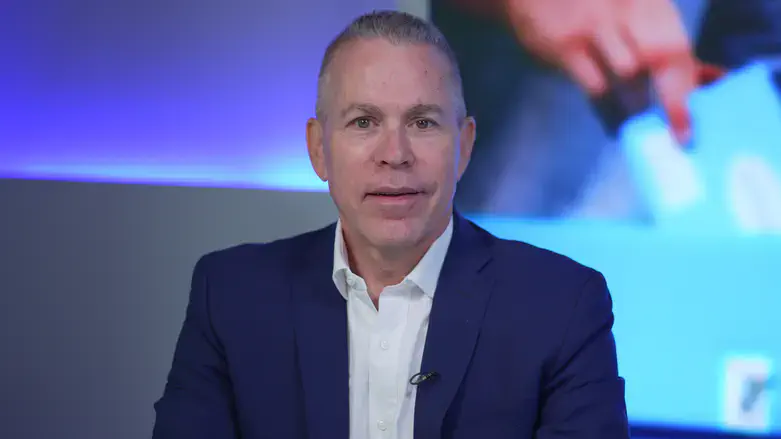
Unity Party chairman, former ambassador and minister Gilad Erdan appeared in the Arutz Sheva studio for an interview and said that Likud has “completely lost touch with the Religious Zionists," and that his party is now “the true home" for the Religious Zionist community.
Erdan addressed the results of the Likud primaries, religious services, the enlistment of Haredim, and the prospects of forming a unity government after the elections.
Referring to the results of the Likud primaries, Erdan said that he views them “with sadness," adding: “It really was once my home, but unfortunately this is not the Likud I knew." According to him, groups such as Agudat Yisrael, Itamar Ben Gvir, and major labor unions influence the composition of the party slate, and “as a result, it is clear to everyone that Likud ministers and Knesset members have almost zero influence over the major decisions."
Erdan said that “almost all the members of the genuine Religious Zionist community... who were in Likud have almost disappeared." According to him, the Unity Party is the new address for this constituency. Erdan, a graduate of the Netiv Meir Yeshiva, leads the new party alongside Yuli Edelstein, Aliza Bloch, and Hezi Nehama - all three of whom also come from the Religious Zionist community.
On the issue of religious services, Erdan said the current situation constitutes a “moral distortion," arguing that the disproportionate influence of the Haredi parties over the appointment of city rabbis and chairmen of religious councils “creates antagonism toward Judaism and tradition even among the secular public." According to him, the balance between Torah study and work with which he was raised is what can change this image in the eyes of the general public.
Addressing the issue of haredi enlistment, Erdan said that he opposes mass arrests and the revocation of voting rights, but called for linking government incentives - such as mortgage subsidies and preferential university admissions - to the obligation to serve: “Serve, and you will receive. If you choose not to serve, you will not receive from the state." He stressed that the policy should apply to secular draft dodgers and the Arab population as well, rather than only to haredim.
At the same time, Erdan said that Torah study is “one of the most important values the Jewish people have," and supported establishing an annual quota of outstanding Torah scholars who would be exempt from military service. Whether that quota should be “5% or 7%," he said, would be determined through agreement between the political blocs. He also called for legislation formally recognizing the State-Haredi education system as an official educational stream, based on the model implemented by former Beit Shemesh mayor Aliza Bloch.
Erdan reiterated that the Unity Party would not join a narrow government, whether headed by Benjamin Netanyahu or Gadi Eisenkot, and declined to express a preference between the two: “What really matters to citizens is the composition of the government." According to him, Israel needs a broad consensus government that would advance an agreed-upon judicial reform and a law requiring service for all.
Erdan explained in the interview that, in his view, a narrow right-wing government would actually have difficulty advancing right-wing values, citing as an example the public protests that erupted over the judicial reform. He argued that the necessary changes to the judicial system can be advanced only through dialogue, negotiations, and broad consensus.
During the interview, Erdan sharply criticized those who encouraged refusal to serve during the protests against the judicial reform. He argued that only a broad government comprising representatives from across the political spectrum would be capable of advancing far-reaching judicial reform with broad agreement, without deepening divisions within Israeli society.
Regarding the differences between himself and Yoaz Hendel and Hili Tropper, who are referred to as the “third bloc," Erdan said that Tropper “comes from the left" and is willing to accept a narrow government dependent on Yair Golan. “That is not my way," he said.
Erdan noted that he gave up the possibility of running for the Likud leadership in order to establish the new party. He said the joint electoral slates would be finalized by the beginning of July and estimated that the bloc has the potential to win between eight and 12 Knesset seats.