
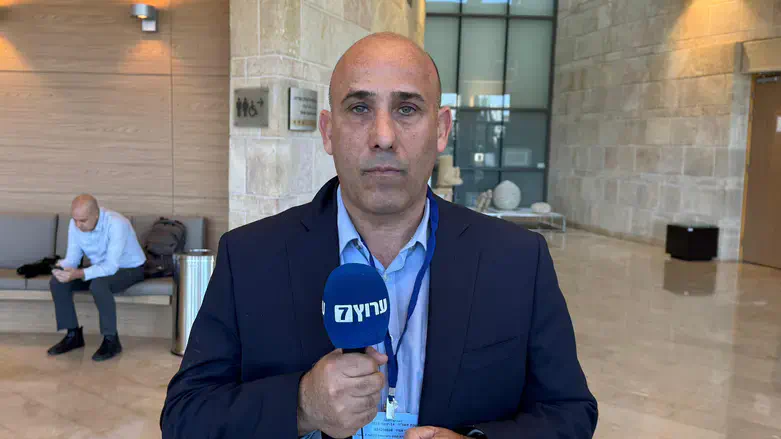
Lt. Col. (res.) Amir Aviv, founder of The Security Zionists, has decided to abandon plans to establish a new political party, saying that the growing number of parties on the right could ultimately threaten the bloc’s ability to form a government. In an interview with Arutz Sheva - Israel National News, Aviv explained that his original decision to establish a party was based on his belief that there was room for another right-wing alternative capable of attracting additional voters from the center-right.
“There is a not-insignificant public that would like a new alternative that would grow the right," Aviv said. “The idea was to establish a party capable of bringing additional seats from the right-of-center."
Aviv said he and his team had already invested significant effort in building the infrastructure for the proposed party, including recruiting candidates and raising donations. However, over the past week and a half, he said, he became increasingly concerned that the growing number of parties could divide the right-wing vote and jeopardize the bloc’s ability to secure a majority.
“I worked with an amazing team to set it up in terms of infrastructure, candidates, donations, etc.," he said. “But in the last week and a half, when I saw the number of parties and understood that it is going to put the rule of the right in danger, I thought it is necessary to consider the good of the state, and the good of the state is for the right to win. If the bloc is put at risk, this is a major problem."
Aviv acknowledged that abandoning the initiative was difficult after the considerable work invested in building the political infrastructure. However, he said the emergence of numerous parties unwilling to unite, as well as uncertainty over whether some of them would ultimately support the right-wing bloc, made it increasingly difficult to create a viable alternative. He pointed to former ambassador Gilad Erdan as one example. Although Erdan identifies as right-wing, Aviv noted that Erdan has said his party would not necessarily provide the 61st seat needed to form a right-wing government.
“That means his party cannot serve as a basis for political unions," Aviv said. “Because the whole idea of the additional party was to be the 61st finger of the bloc and increase it."
Av!iviv also raised questions about Ofer Winter's political framework, saying there was not yet sufficient clarity over whether it would belong to the right-wing bloc or where it stood on key issues.
“There could have been amazing unions; there was room for another party," he said. “But the idea was to bring people who are capable of bringing votes from the other side who have respect both in the right-wing public and in the center public. The conditions for that did not materialize."
According to Aviv, the decision to withdraw was made collectively by the team behind the proposed party. He said he had deliberately sought to build a political movement led by a group of capable people rather than creating a party centered around a single leader.
“We saw that the conditions had not aligned," he said. “In the end, even the right as a whole says that this endangers the bloc, and they want to run with the existing parties and not establish additional parties. We felt very satisfied with this decision."
Aviv was also asked whether he remains open to being placed on the Likud electoral list. He confirmed that the possibility remains, while stressing that the decision ultimately rests with Prime Minister Benjamin Netanyahu.
"I have been working in the security field for several years," Aviv said. “We changed Israel's security perceptions. Everthing we do is for the people of Israel, because the people of Israel is what matters. It is important to win the war and bring prosperity after the war, and we come to serve these goals."