

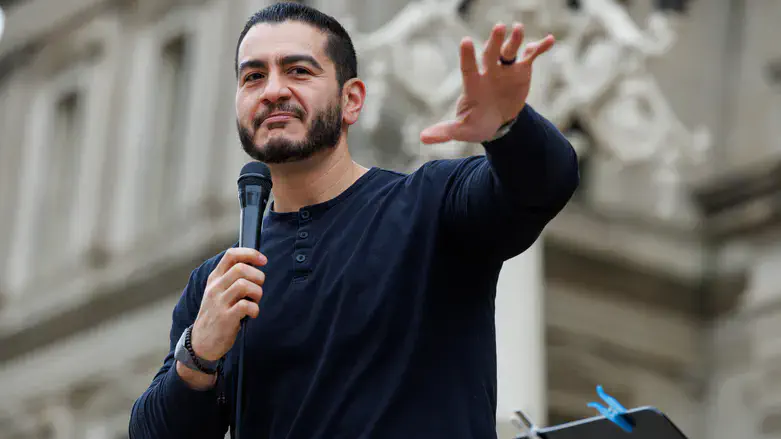
Republican nominee Mike Rogers leads progressive candidate Dr. Abdul El-Sayed 51% to 47% in the Michigan Senate race, according to a recent Fox News poll.
The survey, published Thursday, sampled 1,006 registered Michigan voters online and over the phone between August 6 and August 10. Concerns over ideological positions emerged as a key factor: 54% of respondents expressed extreme or significant concern that El-Sayed's platform is overly extreme, while 51% viewed Rogers as overly aligned with US President Donald Trump.
While El-Sayed enjoys 91% backing among self-identified Democratic voters statewide, his support drops to 69% among Democrats and independents who do not identify with the Democratic Socialists of America. Among independent voters overall, Rogers maintains an edge over El-Sayed, leading 48% to 43%.
Regarding foreign policy, 55% of Michigan voters surveyed favor halting military aid to Israel, compared to 44% who support continuing it.
“Mike Rogers is carrying the momentum and defying the map," Alyssa Brouillet, spokeswoman for the Rogers campaign, told JNS in response. “It’s easy to see why."
“Turns out Michiganders have an issue with Abdul raising their taxes, taking over their healthcare, emptying the prisons and killing their dogs," she told JNS. “They know Mike Rogers will hold the line against this insanity and deliver real results for Michigan. We have a state to save."
El-Sayed secured the Democratic nomination after narrowly defeating Representative Haley Stevens (D-MI) in a high-profile primary that highlighted internal debates regarding the direction of the Democratic Party.
His primary campaign featured intense scrutiny over his foreign policy stances on Israel, notably following his response to an attempted bombing and shooting by a terrorist at a Jewish preschool attached to a Michigan synagogue earlier this year, where he remarked that "hurt people hurt people."
His platform focused heavily on opposing US military assistance to Israel and criticizing its actions in Gaza. El-Sayed accused the Israeli government of genocide, called for ending unconditional foreign aid, and stated during an interview that the Israeli leadership was "as evil as Hamas."
Following the primary result, President Donald Trump launched sharp verbal attacks against El-Sayed.
“When I watch Abdul, he’s full of s--t," Trump stated during a recent event in Nevada, describing El-Sayed as a “man of hate" and alleging that he harbors hostility toward Jewish people.
“He's a communist. And the polls were wrong again last night when they thought it would be a landslide victory for a hater of Jews and a hater of Israel," Trump declared.
Elaborating on his accusations, Trump continued, “This guy hates Jews. Somebody said, ‘Oh, that's a little strong’. No, he hates Jews and he hates Israel…He's a man of hate. And now he's going around saying, ‘No, I love everybody.’ He doesn't love everybody. Put him in office. You're going to find out what he loves."
Trump further asserted that the primary victor “doesn't love Israel. He doesn't love Jewish people. He hates them. He hates them with a passion that burns in his heart."
Looking ahead to the November general election, Trump predicted that Rogers, whom he described as a "great candidate", would win the Senate seat.
“Actually, we do better against the communists, according to every poll. The poll says we do better against the communists. So he won. And so I think I'm happy. I put out a statement: Congratulations to the Republican Party."
El-Sayed has continued his critiques of Israel following his primary victory, acknowledging that Hamas committed war crimes while maintaining his accusation of genocide against the Israeli government.
During an appearance on the Jim Acosta Show, El-Sayed addressed his position directly and said, “I condemned Hamas on day one, right? I think they're wrong. I think they committed war crimes. That's not hard to say."
The progressive nominee then pivoted to Israel's military actions in Gaza, claiming, “I just don't know why it's also not hard to say that in response, the Israeli government also committed war crimes, including genocide."
Framing the conflict as a matter of domestic fiscal policy, El-Sayed questioned American foreign assistance allocations.
“The question for us is ultimately about where we use our tax dollars. That is the political question," he argued, continuing, “I think people like to get involved in this big, long question of what's good for Israel or how we ought to be engaged in a conflict. My point is that our job is not to give money to make the conflict worse. Our job is to use our money here. And I believe that it is up to a free Palestinian people and free Jewish Israeli people to decide what the ultimate peace ought to look like."
He further emphasized that domestic investments should take priority over overseas military financing.
“I just know that right now, our tax dollars are making it far worse. And I don't want our money that could be used to make education and opportunity better for our people to be used to make life worse for other people."