
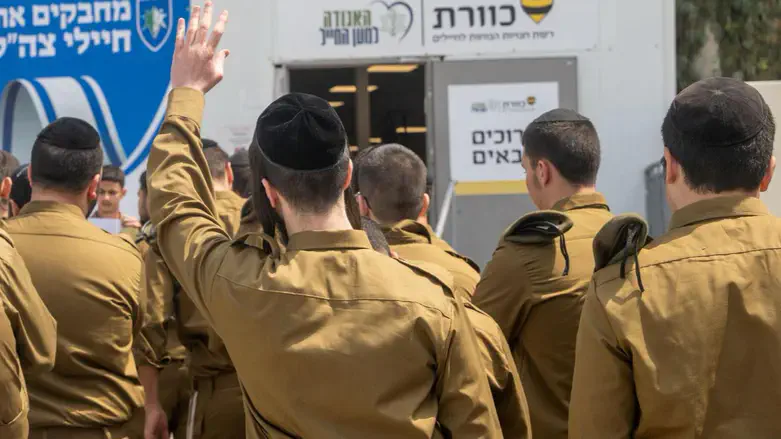
Public discussion about Haredi enlistment generally focuses on the question of how to persuade young Haredi men to enlist in the IDF. Attorney Yaakov Meyuhas believes that the truly important question begins only after the young man has already put on a uniform.
Meyuhas, one of the leaders of the “Haredim in the Army - Preserving Identity" organization, which assists haredi soldiers during their service, says that many of them feel that they are not a natural part of the system.
“The haredi soldier feels like a guest in the army," he says. “That is a feeling that recurs among many soldiers. They enlist out of a desire to serve the country, but quite often they feel that they have to manage on their own and not ask for what they are entitled to."
According to him, this feeling stems not only from cultural differences, but also from the absence of an appropriate support system. “As long as a haredi soldier feels like a guest, it will be very difficult to bring about significant enlistment of additional haredi young men."
To illustrate the reality, he recounts the case of a soldier who served at a large base in central Israel.
“For a year and a half, he brought sandwiches from home because there was no food on the base that met his kosher requirements. He did not want to complain because he felt uncomfortable doing so. He had the feeling that he was a guest, and therefore preferred to manage on his own."
According to Meyuhas, this is only one example of a series of difficulties haredi soldiers experience during their service. The organization seeks to change this reality through personal assistance and by raising awareness of soldiers’ rights.
“A Haredi soldier is entitled to exactly the same rights as every other soldier. The problem is that quite often he chooses not to complain or confront anyone, and in doing so gives up rights to which he is entitled."
Meyuhas also mentions a case in which a unit designated for haredi soldiers was disbanded and its soldiers were assigned to other units.
“There are soldiers who suddenly find themselves in units that do not have arrangements suited to the haredi way of life, including serving together with women. In such cases, it is much easier for a civilian to raise the alarm than for a soldier who is inside the system and subject to military regulations."
He draws on his personal experience from his service in one of the first cohorts of the Netzah Yehuda Battalion.
“We also felt like guests. The army still didn’t know how to ‘digest’ the battalion and its unique needs. On the one hand, the system learned as it went along, and on the other hand, the soldiers themselves arrived without knowing the military system - not even how to deal with a welfare officer."
According to Meyuhas, there is a significant gap between the specially designated frameworks established for haredim and rear-echelon units.
“In the Hasmonean Brigade, there is a better understanding of the needs of the Haredi soldier, but there are still many other units where Haredi soldiers serve, and there they experience things that they should not have to experience."
Nevertheless, Meyuhas opposes relying exclusively on the creation of “separate tracks." In his view, separation actually deepens the feeling of alienation.
“There is no place for funneling Haredi soldiers into only certain units. Just as the army works to open all units to female soldiers, it should also allow a haredi soldier to integrate into any unit. Why shouldn’t a haredi soldier feel comfortable being assigned to Galai Tzahal (IDF Radio)?"
According to him, alongside opening all units to haredi soldiers, there is also room to establish additional frameworks tailored to the haredi community, including a haredi combat-support battalion.
Another issue that Meyuhas says creates difficulties for haredi recruits is the values-oriented content presented during their service.
“When I enter the army by force of law, you cannot at the same time preach things to me that have nothing to do with security. The attempt to turn the army into a melting pot is not the army’s role."
Meyuhas also disputes the argument that Zionist education is what gives a soldier’s service its meaning.
“I don’t think you need to impose a worldview in order for a soldier to carry out his mission in the best possible way. The army’s role is to defend the State of Israel, not to educate recruits according to a particular ideology."
According to Meyuhas, if the state wants to see more haredim enlist, it must ensure that every young Haredi man who enters the gates of the IDF induction center feels that he is an integral part of the IDF.
“The Haredi soldier should not feel like a guest. He should feel that he belongs here - just like every other soldier who serves the State of Israel."