


Yashar! party chairman Gadi Eisenkot distanced himself from Naftali Bennett's pledge to declare Qatar an enemy state if elected prime minister, stressing that such a move carries far-reaching diplomatic and security implications and cannot be made as part of an election campaign slogan.
During a visit to Kibbutz Nir Oz, Eisenkot said there is no dispute regarding Qatar's negative role toward Israel, but emphasized that any decision on the matter must follow a thorough professional review and consultations with all relevant security agencies.
"Israel needs to examine its policy toward Qatar and make orderly decisions," he said. "I know this issue well from my time in the Security Cabinet, and that is why I say it is wrong to make such decisions as a political gimmick or an election slogan. It must be a serious diplomatic and security decision."
His remarks came a day after Bennett pledged that, on his first day as prime minister, he would declare Qatar an enemy state. Bennett argued that Qatar plays a central role in strengthening Hamas and influencing developments in the Gaza Strip, and promised to remove it from any involvement in Israel's decision-making process.
Eisenkot did not dispute the criticism of Doha, saying that Qatar plays "a very negative role" against Israel, both through its activities in Gaza and on the international stage. Nevertheless, he said any policy change must be made only after consultations with the Mossad, the Shin Bet, and the National Security Council, rather than through political declarations.
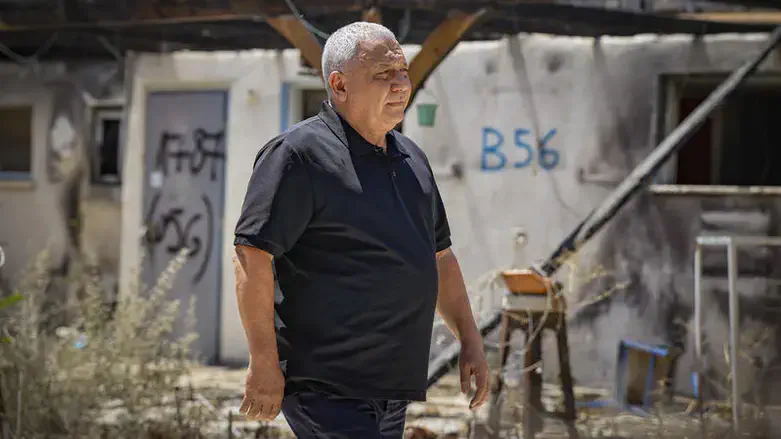
During his visit, alongside former hostage Gadi Mozes, Eisenkot also reiterated his commitment that, if he forms the next government, its first decision will be to establish a state commission of inquiry into the events of October 7.
Addressing the composition of a future government, Eisenkot was asked whether he sees Democrats party chairman Yair Golan as a candidate for defense minister. He declined to commit himself, saying it was far too early to discuss cabinet appointments.
"There are coalition partners and party leaders with more experience who are better suited for the position," he said, adding that the current focus should be on winning the election and establishing "a Zionist, statesmanlike government."
Eisenkot also addressed the security situation in the south, saying he has never regarded Hamas as an organization with which Israel can reach a long-term arrangement. According to him, Hamas is a terrorist organization that must be defeated, stripped of its capabilities, and prevented from threatening Israel, which should act from a position of strength rather than making concessions born of weakness.
On the issue of Judea and Samaria, Eisenkot said that following the October 7 attack, the public discourse surrounding the Israeli-Palestinian conflict should be reassessed. He stressed that this is not the time to discuss permanent-status solutions, but rather to focus on fighting terrorism, strengthening security, and protecting residents of the area.
Eisenkot added that he has never called for the establishment of a Palestinian state, and accused Prime Minister Benjamin Netanyahu of trying to cultivate the image that only he can guarantee Israel's security, despite the events of October 7.