

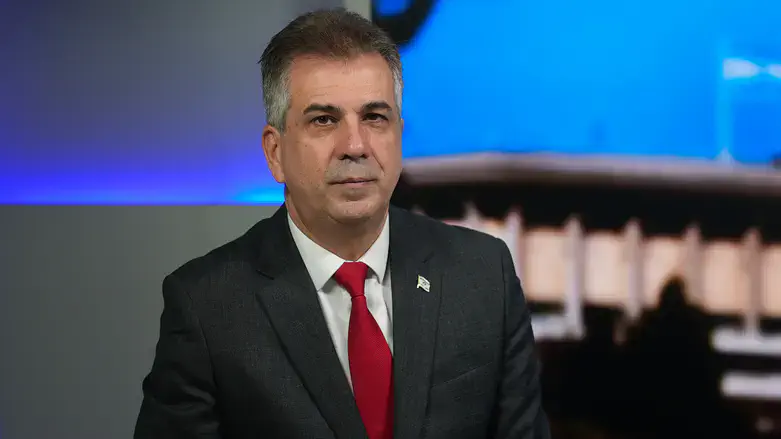
Energy Minister Eli Cohen, who also serves as a member of the Diplomatic-Security Cabinet, voiced support for Prime Minister Benjamin Netanyahu's position on haredi military service, called for the passage of a Draft Law after the elections, and also addressed the campaign against Iran, the future of the Gaza Strip, and the issue of a potential Palestinian state.
In an interview with Kan Moreshet, Cohen said the Likud's position has remained consistent over the years: "Anyone whose Torah study is not their full-time occupation should enlist." He argued that the draft law should have been passed during the current Knesset term and said it should be completed after the elections in a way that preserves the value of Torah study while meeting the IDF's operational needs.
Cohen added that had the legislation been advanced on time, disputes over related bills, including the proposed Basic Law: Torah Study, could have been avoided. He also said the issue was delayed because the Prime Minister was focused on managing the war.
Regarding the haredi perspective, Cohen said conversations with haredi leaders left him with the impression that they, too, agree that those not studying in yeshiva should serve in the military.
Addressing the upcoming elections, Cohen backed Likud's decision to allow the prime minister to reserve slots on the party's candidate list, while emphasizing that most of the list will continue to be chosen through primaries. In his opinion, the upcoming elections will be historically significant, due to the fight against the establishment of a Palestinian state and the need to complete judicial reform.
According to Cohen, Israeli public opinion has shifted to the right since the October 7 massacre, though that trend is not fully reflected in opinion polls. He also criticized Yashar! chair Gadi Eisenkot, Yisrael Beytenu chief MK Avigdor Liberman, and former Prime Minister Naftali Bennett, urging right-wing voters to support Likud.
Regarding the war against Iran, Cohen said the regime in Tehran has refrained from directly attacking Israel because it understands the severity of Israel's potential response. He noted that US President Donald Trump is giving diplomacy another opportunity but said Israel has no confidence in agreements with the Iranian regime.
Cohen also said he believes the United States will act against Iran if it continues violating its commitments, adding that genuine regional stability will only be achieved after the regime in Tehran falls.
"A regime that oppresses its own people and drives them into economic collapse cannot continue to exist," he warned.
Regarding Gaza, Cohen said Israel is committed to giving diplomacy a chance if it includes Hamas disarming, but estimated the likelihood of the terrorist organization agreeing voluntarily is low.
"If that doesn't happen, we have the ability to do it ourselves," he said.
Concluding the interview, Cohen addressed plans for "the day after" the war in Gaza, explaining, "Experience has proven that where there is no settlement, there is no security."
Noting that proposals to rebuild Jewish communities in northern Gaza are being examined, he promised, "There will be only one state between the Jordan River and the Mediterranean Sea - the State of Israel."