

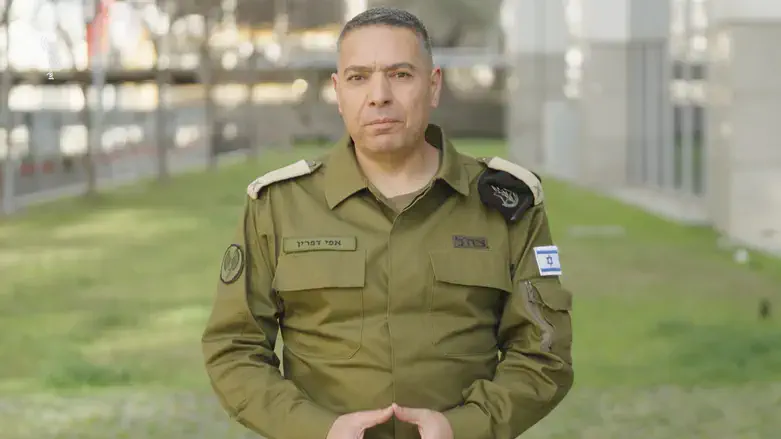
Twenty years have passed since the Second Lebanon War, but for IDF Spokesperson Brig. Gen. Efi Defrin, the memories of the Battle of Wadi Saluki remain vivid as if they happened yesterday.
In a special interview for an IDF podcast, Defrin returned to the battle in which he served as commander of Battalion 9 of the 401st Armored Brigade, was seriously wounded, lost consciousness, and the dramatic call "A commander has fallen" was heard over the radio network.
"When people tell me that twenty years have passed, it sounds like a very long time," he said. "But for me, it feels as if everything happened yesterday. There is something about being a battalion commander in war that stays with you for the rest of your life."
Defrin recalled that even before entering Lebanon, a sense of readiness and urgency prevailed among the battalion. The commanders wanted to be among the first forces to enter the fighting, and after receiving orders, the battalion moved north and began final preparations for the mission. He also remembered how commanders were forced to improvise and obtain maps themselves after discovering that basic navigation equipment was missing for the planned operation.
According to Defrin, the mission was to penetrate deep into Lebanese territory, cross Wadi Saluki and advance toward the Litani River, with the goal of striking Hezbollah's combat infrastructure and pushing the threat away from northern Israeli communities. "We understood that we were entering one of the most dangerous areas in Lebanon," he said.
On the night before entering Lebanon, Defrin called his wife, who had given birth shortly beforehand to their third daughter. He said he understood the danger of the mission he was embarking on but struggled to find the right words. "I thought about how you say goodbye. What do you say? Is this the last conversation? In the end, we had a completely ordinary conversation, and afterward I sent her a text message with the words of the song that accompanied us at our wedding - 'Endless Meeting' by Nathan Alterman. After that, we entered Lebanon."
The battle itself unfolded during the morning hours of the final day of the war. After lengthy delays before crossing the wadi, Defrin decided to move at the front of the force. Moments before the advance, he transmitted an order over the radio that would remain etched in his memory: "In the passage between one and two tanks, they will be hit. Do not stop. Keep moving forward."
Shortly afterward, the shooting began. "Suddenly I heard a massive explosion. For a moment I thought the gunner had fired a shell. Then there was another explosion. I looked back and saw flames. I realized they were firing at us. They had been waiting for the command tank."
Despite the hit, he continued ordering the forces to move forward, but within seconds the tank was struck again. "I felt like a powerful kick in the stomach, and then everything went dark."
Defrin lost consciousness inside the tank. Among the few memories that remained from that day, he described lying at the rear opening of the tank, hearing the crew members shout, "We're losing him," and then waking up only in the hospital.
As he was evacuated from the battlefield, the call "A commander has fallen" was heard over the radio network, a message that severely affected the fighters' morale. However, company commanders continued leading the mission exactly as he had instructed them before he was wounded. The battalion advanced up the mountain under heavy fire, suffered severe losses, but completed its mission before the ceasefire took effect the following day.
When he awoke in the hospital, Defrin said, he initially did not understand where he was. Only after seeing his wife with their newborn daughter did he begin reconstructing what had happened. "Suddenly I remembered that I was a battalion commander. I tried to get up and issue orders, and then I realized I was tied to the bed and connected to tubes."
The first thing he asked about was not his medical condition. "I asked for a piece of paper and a pen and wrote: 'What about the battalion? What about Shai?'" Shortly afterward, he was informed that company commander Shai Bernstein, Ami Meshulami, and Ido Grabovsky had fallen in battle, and additional soldiers had been wounded. "That is a silence that has stayed with me to this day," he said.
Despite his injuries, Defrin said he returned to the battalion within weeks to meet with the soldiers, conduct a battle debriefing, and visit bereaved families. "I couldn't stay in the hospital while my battalion was there. I felt that my place was with my people."
Even two decades after that morning in Lebanon, Defrin acknowledges that the battle remains with him every day. "The images, the names, and the faces of the fighters stay with you. As a commander, you carry them for the rest of your life."